
Nobody at the grading desk knows what your card looked like on your kitchen table. They only know what arrived. A soft corner picked up between your house and theirs is indistinguishable from a soft corner the card has carried since 1999 — and it is graded exactly the same way. Packing is not the admin at the end of the job. It is the last stretch where you are still the one deciding the grade.
▸ THE QUICK VERSION
Declare an honest value first. It sets your service tier, your return insurance, and whether the order gets held for an upcharge.
Clear penny sleeve, then a semi-rigid holder. No toploaders, no magnetic cases, no tape, no tabs, no writing.
Stack in form order, item 01 on top, capped with cardboard and banded snug — not tight.
New box, zero slack, paperwork inside, tracked and insured on the way in.
Start with the number, not the box
DECLARED VALUE RUNS EVERYTHING
Before you touch a sleeve, settle on a declared value for each card, because that one figure decides three separate things: which service tier you are allowed to use, how much insurance rides on the return leg, and whether the order sails through or stops for a conversation. Graders reserve the right to reprice an order when a card lands in a value bracket well above what was declared, and the slab does not come home until that is settled.
Base the number on recent completed sales for the card in the condition you are actually sending, not on the price of a flawless example of it. Undercooking the figure to save on the tier is a bad trade twice over: it invites the upcharge, and it caps what you get paid if the parcel disappears. Pricing, tiers and turnaround windows all move — check the current service pages before you commit, and read how to pick the right PSA tier for the full breakdown.
What is allowed to touch the card
THE PREP VOCABULARY
Card preparation is a closed list, and a short one. Each card goes into a clear penny sleeve — clear, never coloured or opaque, because a grader has to read both faces without taking anything apart. The sleeved card then slides into a semi-rigid holder of the Card Saver type, sitting square in it with both faces readable. Which way up the sleeve goes is not a rule the grader publishes, and the hobby is genuinely split on it: load it open end down and the sleeve’s only exit faces the sealed base of the holder, so nothing can walk out on a conveyor; load it open end up and the card lifts out cleanly at the far end. For anything going in the post I load it open end down.
Everything else on your desk is a liability. Rigid and sealed holders have to be dismantled before the card can be looked at, which is why the published packing guidance tells you not to send them. What actually happens to an order that turns up prepped wrong is whatever the submission terms in force that day say happens — and that wording gets rewritten, quietly, whenever the grader reorganises its services. Read the current packing and shipping guide on the day you send, not a forum post from two years ago.
Every layer you add takes one
movement away from the card.
Seal it when nothing
is free to move.
The slack ladder
EVERY LAYER KILLS ONE MOVEMENT
One idea sits underneath all of this, and once you have it you can pack anything. A parcel is a stack of layers, and each layer exists to remove exactly one way the card can move. The sleeve removes surface rub. The semi-rigid removes bend. The cardboard removes flex across the whole stack. The bands remove cards sliding against each other. Bubble and fill remove the brick shifting inside the box. The box itself takes the drop.
Slack is cumulative, and it only runs one way: whatever movement is still available when you seal the parcel is the movement that will actually happen, a few hundred times, on a conveyor. So work down the ladder and ask at every rung what is still free to move.
Build the brick
ORDER, CARDBOARD, BANDS
Stack the holders in the exact sequence your online submission lists them, item 01 on top. This is the most common self-inflicted delay in the hobby: a stack that reads bottom-up against a form that reads top-down has to be reconciled by hand before a single card gets looked at. Nobody publishes a penalty for it, and you should not expect a bill. What you pay is time — an order that could have been checked in against the form in one pass instead waits for somebody to work out which holder is which, and it waits at the front of the process, before the clock most people are watching has even started.
Cap the stack top and bottom with two pieces of stiff cardboard cut slightly larger than the holders, so the edges of the cards are the last thing anything can reach. Then band it: one band each way, crossed, snug enough that nothing slides and loose enough that you can slip a fingertip underneath. A band pulled tight is not extra safety, it is a press, and a press leaves its mark down the long edges of the holders and the cards inside them. Sending a lot? Build several modest bricks rather than one heroic one.
Shake the banded brick before it goes near a box. If the cards click inside the cardboard, the bands are in the wrong place — not too loose.
A box that cannot shift
THE OUTER SHELL
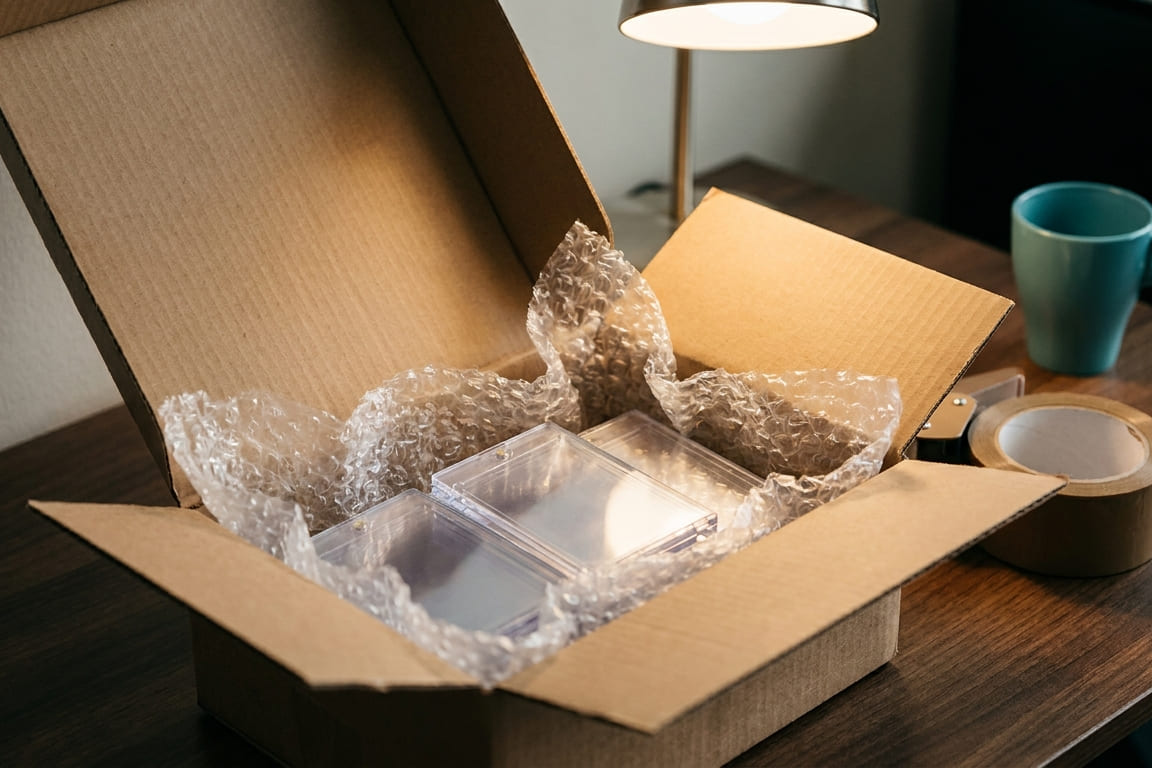
Wrap the brick in bubble, then set it in the middle of a new corrugated box — not the tired one your last order came in, whose corners have already been crushed once and will not do it again. Fill every side until the brick cannot travel. The standard is not “well padded”, it is “nothing moves when you shake it hard”. Loose fill that settles in transit turns a snug box into a rattling one somewhere over Kansas.
- Paperwork inside. Print the confirmation pages from your online submission and put them in the box. That paperwork is the only thing marrying your parcel to your order.
- Tape every seam. Proper packing or security tape across all edges — not painter’s tape, not reused tape, not string.
- Nothing on the outside that advertises what is inside. A boring box is a safe box.
- Photograph the pack-out — the brick, the filled box, the sealed box, the label. Two minutes now is your entire case later.
What the insurance actually covers
THE LEG YOU DO NOT CONTROL
Two shipping legs, two different arrangements. The trip in is yours: you pick the carrier, and you buy tracking and insurance to the same declared value you put on the form, with signature on delivery wherever it is offered. The trip home is arranged for you rather than by you, and billed as part of the order. How that return charge is worked out, and what tracking and cover come with it, is set by the submission terms in force on the day you send — and any cover of that kind has ceilings. Read the current shipping and insurance terms before you commit anything serious to the post.
Then be clear what it covers. Insurance pays out when a parcel is lost or physically destroyed in transit. It does not pay when a card arrives intact and grades lower than you hoped, it does not pay for a corner you rounded yourself, and it does not pay a claim you cannot evidence. It is protection against the mail, never against the verdict. Ship early in the week rather than into a long weekend, so nothing sits in a depot for three days, and keep the tracking number somewhere you will still find it in two months.
After the tape
THE PART THAT IS OUT OF YOUR HANDS
Once the label is scanned your involvement is over until the order surfaces in the tracker and starts moving through its stages. Refreshing does not move it. Note the date it was received and go and do something else: the wait is the only stretch where nothing you do can hurt the card. If you did the twenty minutes properly, the number that comes back is a fact about the card rather than a fact about the mail.
Step three of this chapter picks the story up from that first scan — how to track a PSA submission covers where the submission number comes from, why the posted turnaround does not start on the day you ship, and which stage changes are worth reading anything into. Keep the pack-out photographs until the slabs are back in your hands, not until the tracking says delivered.
Ian’s longer piece on shipping a card that arrives a 10 covers the same discipline for sales and trades, where the packing is close cousin to this and the tape rules are yours to set.