01
How to check a cert number before you pay
The registry lookup, what a good result actually shows you, and the three ways a real number ends up on the wrong object.
GUIDE · 1200 WORDS
 How To: Gaming
THE HOW TO CO. — EDITION 10
How To: Gaming
THE HOW TO CO. — EDITION 10
An autograph is the only part of a collectible that was added after the factory finished, by hand, once. Everything on this case is about the second person — the one who was standing there, or who looked at it afterwards and put their name to an opinion.
CASE 02 · OPENED
Two signed covers, the same pen, the same afternoon. One is worth four times the other, and the difference is entirely a question of who else was in the room.
Authentication and grading are two different services that arrive on the same piece of card, and confusing them is the most expensive mistake on this shelf. Authentication answers one question: is this ink what the seller says it is. Grading answers a different one: what condition is the object in. A piece can be authenticated and ungraded, graded and unsigned, or carry both — and the price of the third is not the sum of the first two.
There are only two ways a signature gets authenticated, and they are not close. In the first, somebody from the service stands at the table and watches the pen touch the item, then takes it away and seals it. That is a witnessed signing, and what it produces is not an opinion — it is a record of an event. In the second, the piece arrives in the post years later and an examiner compares it against exemplars: slant, pressure, the order the strokes were laid down. That is expert judgement, and expert judgement is a probability wearing a certificate.
Which is why a certificate of authenticity is worth exactly what its issuer is worth, and not a penny more. A COA written by the seller is a sentence the seller wrote about themselves. A COA from the promoter who ran the signing is worth something while the promoter still exists. A COA from a service that keeps a public registry is worth something because you can go and check it: type the number, and either the object comes back on screen with its own photographs or it does not. If the number does not resolve, the paper is decorative.
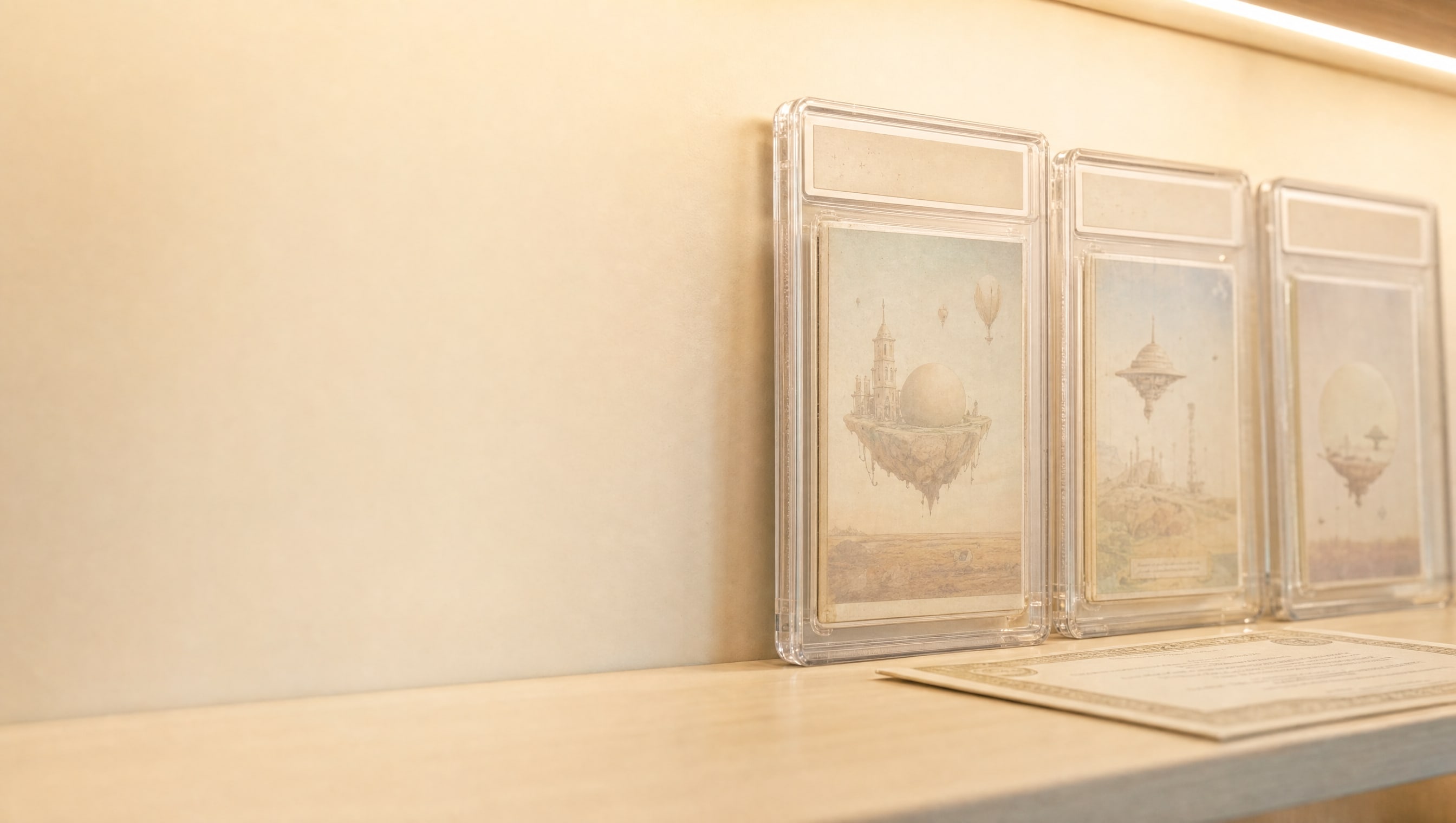
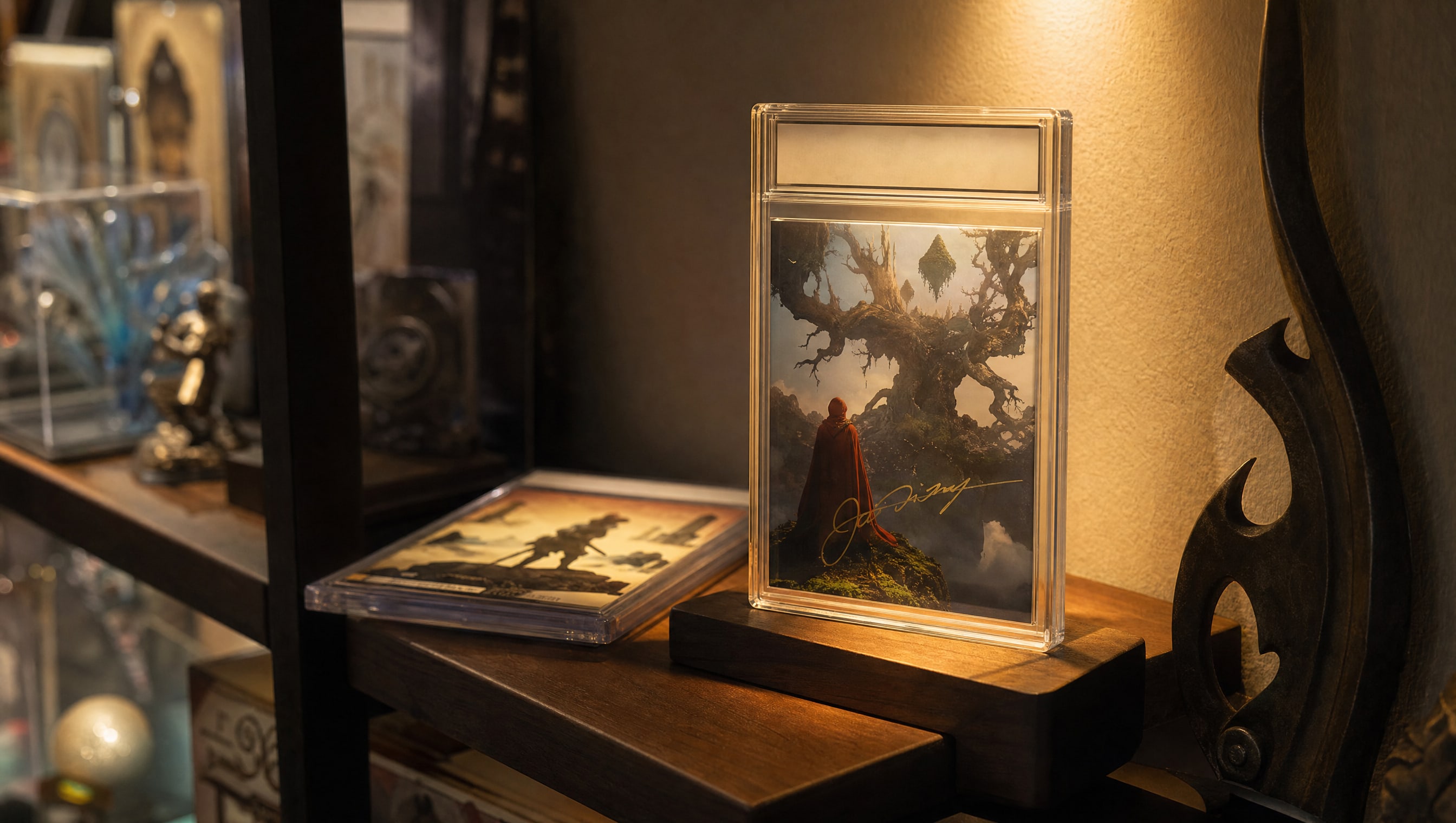
The slab is what happens when the claim is taken out of everyone's hands. The piece is sealed inside a tamper-evident holder with the service's label at the head, and from that moment the object is unhandleable and unphotographable and, in the market's eyes, is the number on the card. Cracking the case to look more closely destroys the grade, because the grade was never about the object alone — it was about the object inside an unbroken seal.
THE DETAIL
Ninety millimetres of printed card, and the only part of a graded piece anyone reads. Eight zones are printed on it and every one of them is doing work: who is standing behind the number, whether the signing was watched or merely received, the number that has to resolve in a public registry, what the service says the object is, two grades scored on two different scales, and a two-letter qualifier — OC here, for off-centre — that can quietly halve what the first of those grades means. Beside it, the holder at life size — because the label is not a document you can separate from the object. Underneath, the two rulers themselves.
TWO NUMBERS · TWO RULERS
The object
Scored from 1 to 10 in half points, poor at one end and gem mint at the other. Almost all the money lives in the last point and a half, where the steps are smallest.
MARKED HERE AT 9.4 · MINT
The signature
Scored 1 to 10 in whole points, and only by some services. Others authenticate the ink and never grade it, so a slab with no second number is not a slab with a bad one.
MARKED HERE AT 10 · WITNESSED
FROM THE CURATOR
Everybody buys with their eyes on this shelf, and the eyes are the part being aimed at. So I do it backwards. The cert number goes into the registry first, on my own phone, before I have formed an opinion about anything — and what comes back should be the same object, the same grade and the same photographs the seller is showing me. Twice now it has come back as something else entirely: right service, real number, wrong item. A label can be lifted off a cheap slab and set into a better one. A ledger entry cannot be moved.
BY POPPY — CLASS: CURATOR · THEPINKPIPER.GG
5 PIECES · IN THE ARCHIVE
The pieces commissioned for this case. Titles are set here before they are written, so the case shows its shape — nothing links yet, because a label pointing at an empty case is worse than a label that says wait.
01
The registry lookup, what a good result actually shows you, and the three ways a real number ends up on the wrong object.
GUIDE · 1200 WORDS
02
Why the label wording matters more than the logo, and what a service is really promising when it says authenticated.
EXPLAINER · 1100 WORDS
03
Service, cert, description, both grades and the qualifier — in the order they change what the piece is worth.
HOW-TO · 900 WORDS
04
What sealing costs you: handling, light, the second opinion you can never get, and the pieces that are worth more unslabbed.
GUIDE · 1300 WORDS
05
Ink fades faster than the thing it is written on. Mount board, glazing, and the drawer that does the damage.
HOW-TO · 1000 WORDS
SHELF 07 / 07 · MEMORABILIA
Every chapter in this region is a bay on this wall. This one is 07. Back to the wall to walk the rest.