01
How to tell licensed merch from a bootleg before you pay
The four printed marks, in the order they cost a forger money — and the two photographs to ask a seller for.
BY POPPY · 7 MIN
 How To: Gaming
THE HOW TO CO. — EDITION 10
How To: Gaming
THE HOW TO CO. — EDITION 10
An art book, a pressing of the soundtrack, the jacket out of a collector’s edition. What separates the one worth keeping from the copy standing beside it is not the price — it is a chain of permission, and the chain prints itself on the box.
CASE 03 · OPENED
Three words the side shelf uses as if they were a ranking. Two of them describe the same arrangement, and the third describes an object with nothing behind it at all.
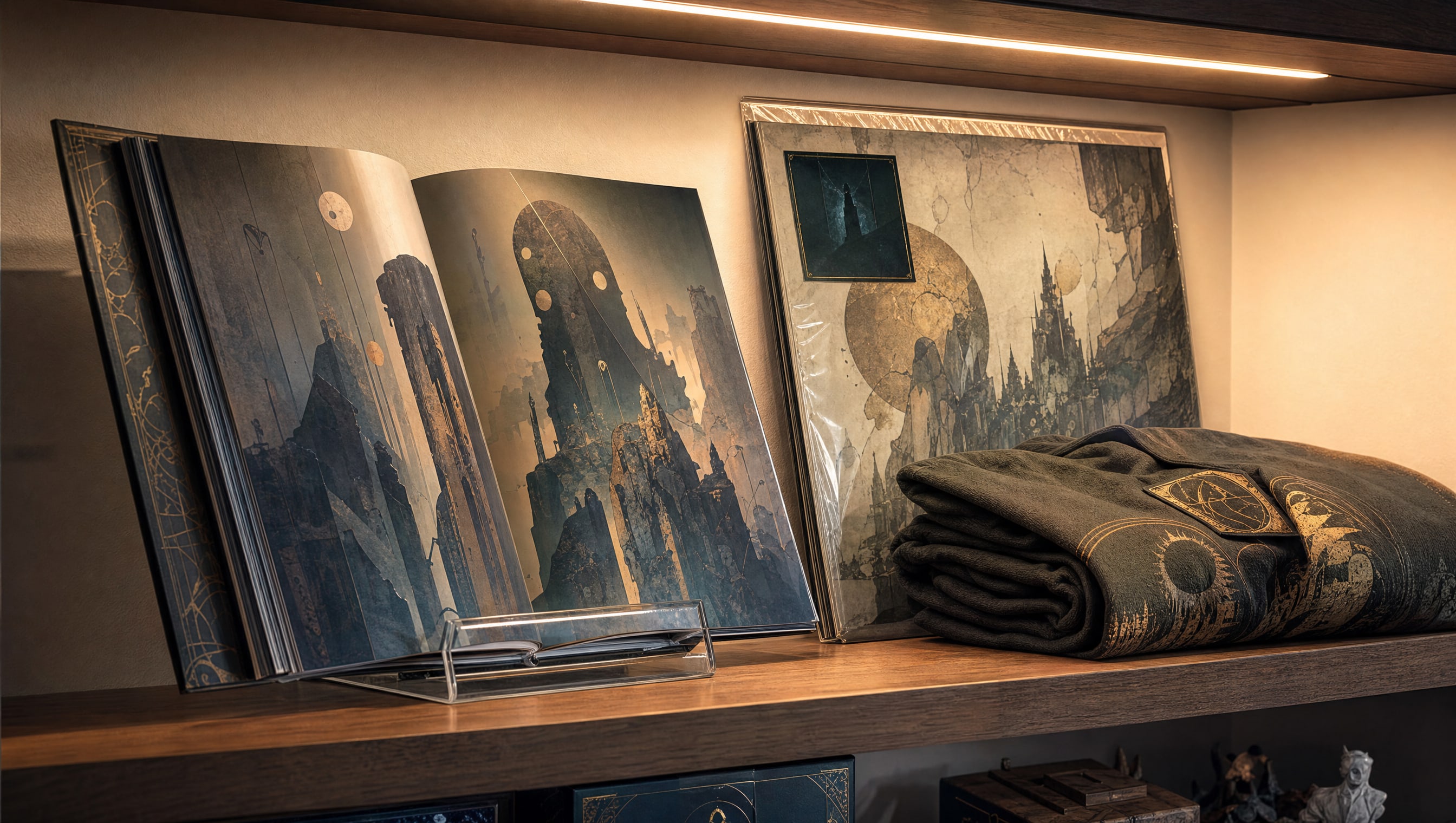
Almost nothing on this shelf was made by the people who made the game. An art book is printed by a book publisher. A soundtrack is pressed by a record label with a plant booking. A jacket is cut and sewn by a clothing manufacturer with a factory in another country. None of that makes any of it unofficial. It makes it licensed, which is a specific arrangement, in writing, and the only reason the object exists.
The arrangement runs in one direction and it has three links. The studio or its publisher owns the work. It grants a second company the right to make a defined thing, in a defined territory, for a defined period — almost always with an approvals step where artwork and samples are signed off before tooling is cut. That company makes it and gets it into shops. You meet it at the third link, and by then everything that decides what the object is has already happened.
First-party merchandise is simply the case where the first two links are the same company: Nintendo’s own goods, a publisher’s in-house store, an amiibo. Collectors treat that as a grade above licensed. It is not a grade at all — it is a note about who owned the factory relationship. Some of the best-made objects on any side shelf are licensed precisely because the licensee is the specialist and the studio is not: printers who bind books properly, labels who cut lacquers properly.
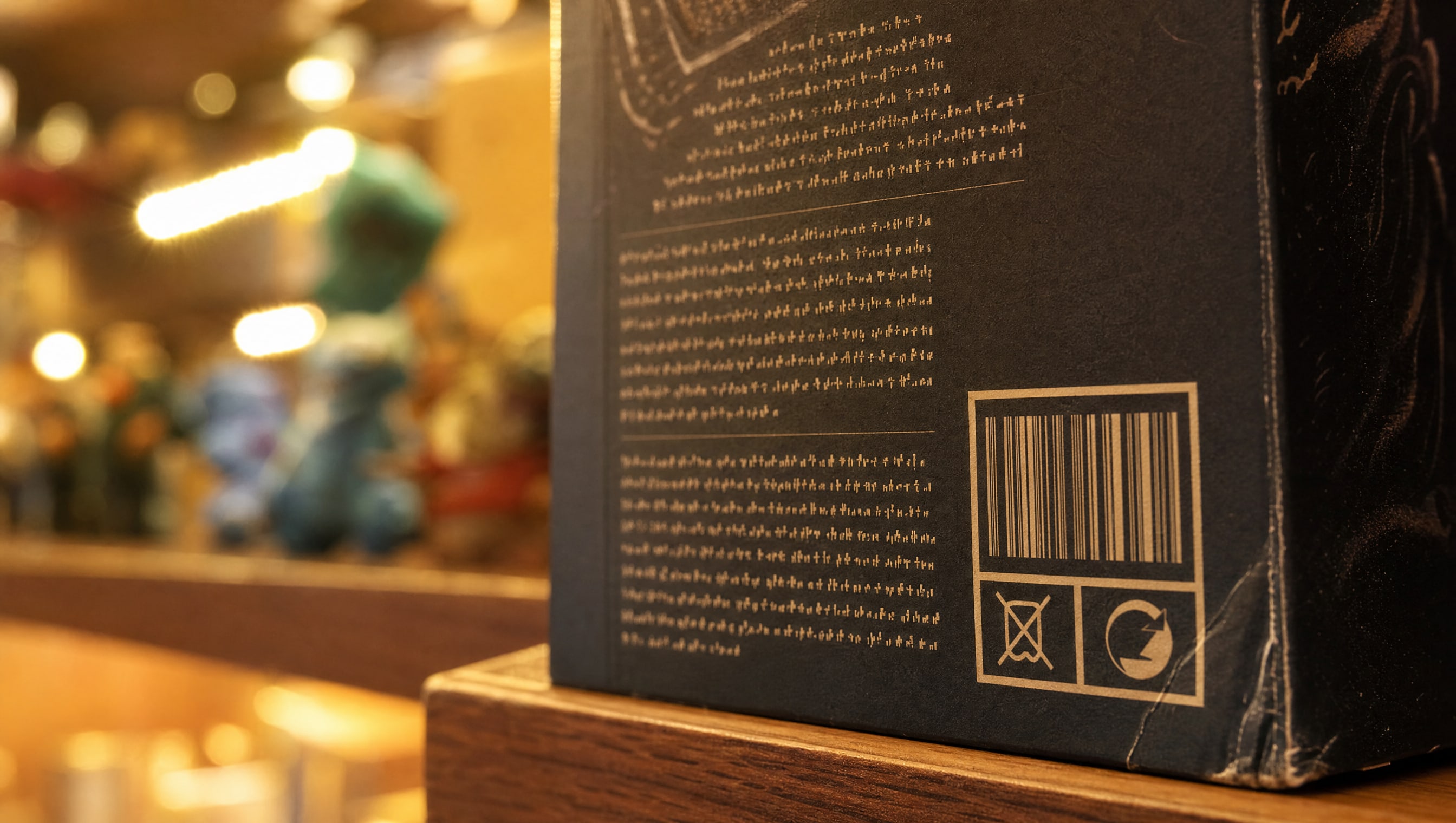
A bootleg is not a cheaper version of that. It is an object that arrives at the same shelf with none of the links behind it — nobody granted anything, the artwork was taken, the run has no number and no approval and no record. It is not always crude. Bootleg pressings and pirated art books can be good enough to survive a photograph. What they cannot easily fake is the block of small print the chain forces onto the packaging, because that print names companies that have addresses and legal duties.
THE DETAIL
Permission is not a mood. It is a chain of named parties, and each link leaves a different mark on the finished object: a copyright line for the first, a maker’s name and an address for the second, a catalogue number and a barcode for the third. The axis counts those links and nothing else — a licence has a term and a territory, but no duration this page could honestly draw. Watch the fourth link. It reaches the same shelf as the other three, and there is nothing behind it.
THE PRINTED BLOCK · IN ORDER
Turn the object over before you turn over any money. Read the small print in this order — cheapest claim first, hardest thing to counterfeit last — and most of what the listing said stops mattering.
READ IN THIS ORDERWHAT IT COSTS A FORGER
5 PIECES · IN THE ARCHIVE
The archive behind this label. Titles are set here before the pieces are written, so the case shows its shape — nothing links yet, because a label pointing at an empty case is worse than a label that says wait.
01
The four printed marks, in the order they cost a forger money — and the two photographs to ask a seller for.
BY POPPY · 7 MIN
02
Who has to be named, how the wording usually runs, and the misspelling that gives away a copied panel.
BY IRIS · 5 MIN
03
Catalogue numbers, matrix runouts and the pressing that was never announced by anybody.
BY POPPY · 8 MIN
04
Standing, leaning, stacking, and the sunlight that takes a printed spine before it touches the boards.
BY POPPY · 5 MIN
05
Countable runs against reprints — why books and pressings hold and apparel almost never does.
BY IRIS · 6 MIN
SHELF 07 / 07 · MEMORABILIA
Every chapter in this region is a bay on this wall. This one is 07. Back to the wall to walk the rest.