01
How to count the turns you actually have left
The end trigger sets your budget. Everything after that is arithmetic you can do between other people’s turns.
BY POPPY · 5 MIN
 How To: Gaming
THE HOW TO CO. — EDITION 10
How To: Gaming
THE HOW TO CO. — EDITION 10
Tempo, efficiency, position, information. Every turn you have ever taken was one of those four wearing a costume — and on most turns, only one of them is really being asked.
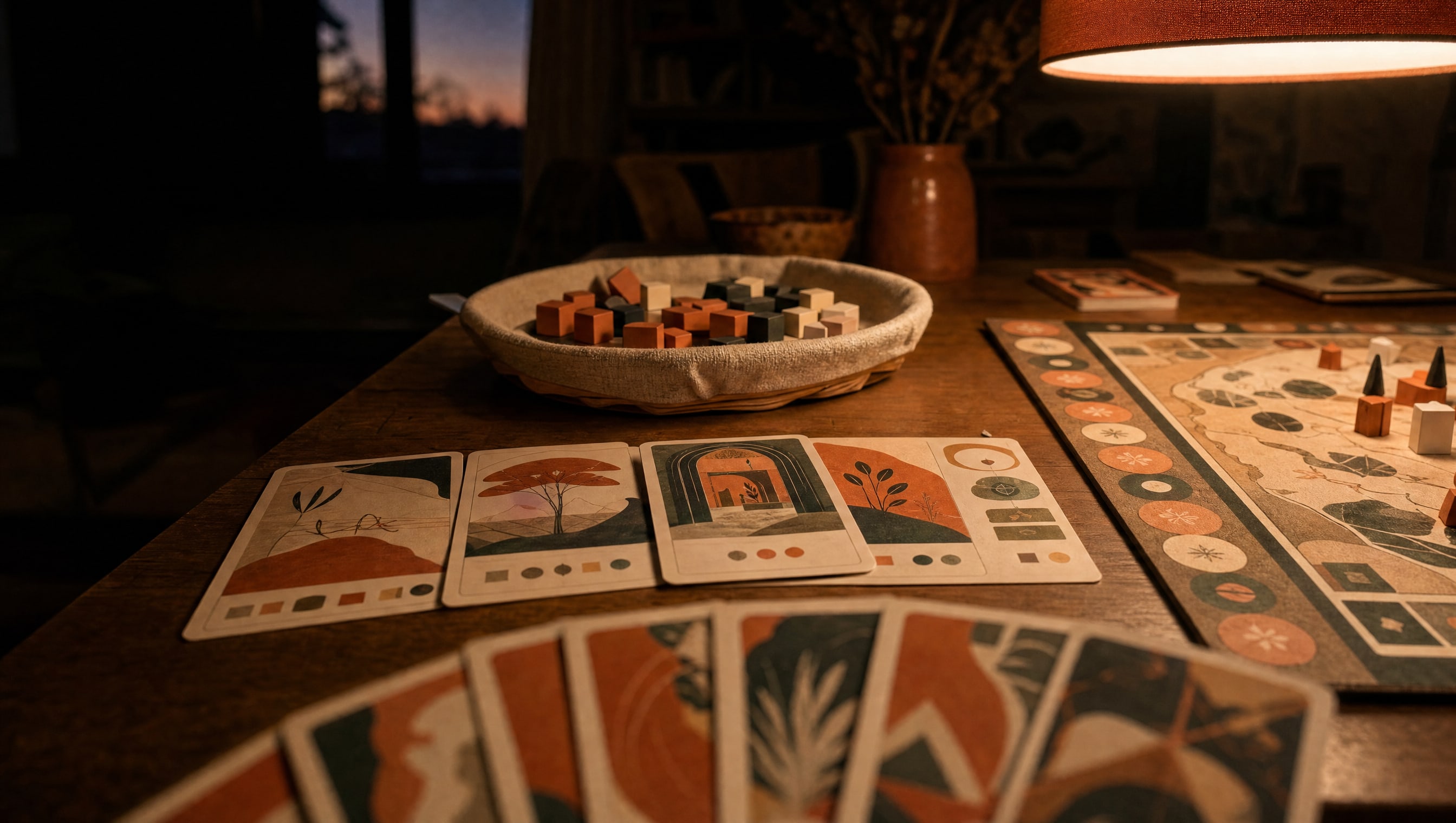
BEFORE ANY OF THE CLEVER PART
Four questions. Most turns only ask one of them loudly.
Strategy sounds like foresight and mostly is not. The people who beat you at your own kitchen table are rarely seeing further ahead than you are — they are asking a shorter question. Everything a board game puts in front of you is one of four decisions: how fast, how cheap, how much room, how much do you know. On any given turn two or three of them are noise. The skill is not answering all four well. It is noticing which one is actually being asked, and then answering that one with a number instead of a feeling.
Turns are the only thing at this table you cannot make more of. A purchase is never good or bad on its own; it is good or bad in the number of turns left to use it. Work out the turn a thing pays for itself, subtract that from the turn the game ends, and you have the only number that matters. Bought on turn eight of ten, the best engine in the box is a souvenir.
COUNT: TURNS BETWEEN PAYBACK AND THE LAST TURN
Every action has a price, and beginners compare totals when the game is scoring rates. Four points for four actions loses, comfortably, to three points for two — and the gap compounds, because the player spending less per turn has spare turns to spend on something else entirely. Do the division before you commit, not while you are tidying the box.
COUNT: POINTS PER ACTION, NOT POINTS
Position is what is still available to you when the turn comes back round. The strong seat is not the one that scored this turn; it is the one that still has three moves it would be happy to make after everybody else has taken theirs. In worker placement it is literal — count the spots you actually want, then count how many players act before you do.
COUNT: MOVES YOU WOULD STILL BE HAPPY TO MAKE
Information is the part of the game you can name. A sixty-card deck with eighteen cards face up is thirty per cent known, and that is not trivia: it is the difference between hoping and counting. Track what has gone rather than what is left, and watch the player who quietly stopped competing for the obvious points. They are scoring somewhere you have not looked.
COUNT: WHAT HAS GONE, NOT WHAT IS LEFT
THE DETAIL
A compass rose rather than a radar chart, and the difference is the whole argument. Tempo is counted in turns, position in moves you would actually take, efficiency in points per action, information in per cent of the deck you can name — so there are no rings joining the arms, because a ring would claim that six turns and six open moves are the same distance from the middle. They are not. Read one arm at a time. The four short points between them are the trades: each pair of questions argues with the other, and every hard turn you have ever had was one of those four arguments. The diamonds are one worked turn — turn four of ten, the engine on the table at three actions, or three points you can take right now.
5 PIECES · ON THE TABLE
Five pieces queued for this space. Titles are set and the drafts are moving; nothing is linked here until the page exists, because a door that opens onto nothing costs you a click to find out.
01
The end trigger sets your budget. Everything after that is arithmetic you can do between other people’s turns.
BY POPPY · 5 MIN
02
Points per action, not points. The move that scores more is usually the move that quietly costs a whole extra turn.
BY IRIS · 4 MIN
03
Rushing is not tempo. Tempo is choosing which turn to spend; panic is spending whichever one is in front of you.
BY POPPY · 6 MIN
04
Room is worth points right up to the turn it stops being worth anything, and the whole trick is knowing where that turn is.
BY IRIS · 5 MIN
05
Count what has gone rather than what is left, and watch whoever stopped competing for the obvious pile three turns ago.
BY POPPY · 6 MIN
FROM THE CURATOR
For years I played every turn as though all of it mattered equally, which is exhausting and, it turns out, wrong. Now I ask one thing before I touch anything: which of the four is this turn about? Most of the time the answer is obvious and boring — it is a tempo turn, take the fast thing, move on. Two or three times a game it is not obvious, and those are the turns that decide it. Everything I used to call being good at board games was really just spending my attention on the turns that were worth it.
BY POPPY — CLASS: CURATOR · THEPINKPIPER.GG
SPACE 06 / 16 · CHAPTER 03 · PATH 01 OF 03
CHAPTERS ON THIS BOARD
Every chapter in this region is a space on this board. Space 06 is Strategy & Skill, and this page is the first of the three paths that run off it. Back to the board to roll for another.