01
How to read a dice game before you spend your first roll
Every dice game prints its own odds on the board. Find the numbers it pays on, and the box has told you what it wants.
BY POPPY · 6 MIN
 How To: Gaming
THE HOW TO CO. — EDITION 10
How To: Gaming
THE HOW TO CO. — EDITION 10
A deckbuilder and a dice engine are one machine in two coats: a bag of outcomes you are allowed to edit. Count it, thin it, and stop calling the result luck.
VARIANCE IS NOT LUCK
Nobody at this table is unlucky. You are all rolling the same thirty-six numbers.
Deckbuilders and dice games take more blame than any other shelf in the hobby, and they are the two shelves where the arithmetic is smallest and most usable. Two dice have thirty-six outcomes and you can write every one of them on the back of the score pad. A deck-builder has one number worth knowing and it is five, because five is how many cards you get to see. Everything past those two facts is bookkeeping.
The spread below is the whole of the dice half. Seven is not lucky — it is available: six of the thirty-six ways two dice can fall add to seven, and exactly one of them adds to twelve. So a space that pays on six, seven or eight is offering you 44% of every roll you will ever make, and a space that pays on twelve is offering you 2.8% and a story. Neither one is a mistake. Taking the twelve and then being surprised is the mistake.
A deck-builder runs the same machine with different furniture. Your deck is the bag of outcomes and your hand is the roll, and the one thing that separates the two is that you are allowed to reach into the bag and take things out. That is the whole reason thinning is the strongest move in the genre and the one new players skip: buying a card makes that card possible, but thinning a card makes every card you already own more likely, all at once, forever.
The ledger under this is what that sentence costs in numbers. Nothing in it is an opinion — it is five cards off the top of a shuffled deck, and it is the reason the strongest turn in a deck-builder is very often the turn you buy nothing at all.
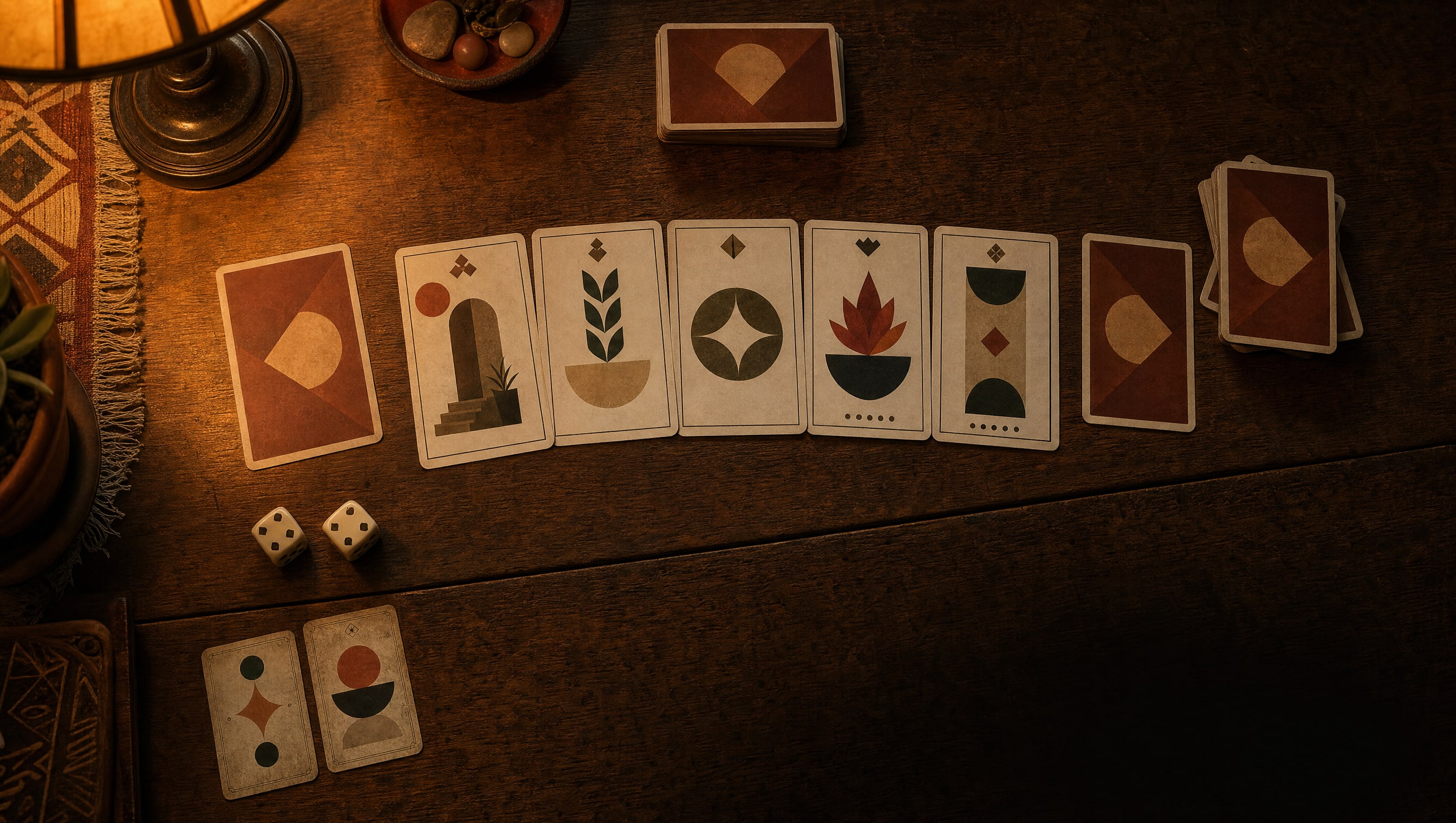
HOW THESE NUMBERS ARE WORKED
FIVE CARDS OFF THE TOP OF A SHUFFLED DECK
THE ODDS THAT AT LEAST ONE COPY IS IN THAT HAND
| DECK SIZE | ONE COPY | TWO COPIES |
|---|---|---|
| 8 cards | 62.5% | 89.3% |
| 10 cards | 50.0% | 77.8% |
| 12 cards | 41.7% | 68.2% |
| 16 cards | 31.3% | 54.2% |
| 24 cards | 20.8% | 38.0% |
Read the middle column as the price of every card you buy: at ten cards a card you own once turns up in 50.0% of hands, at twenty-four it turns up in 20.8% of them, and you did nothing to that card except buy other cards. Read the right column as what thinning pays: trash four dead cards out of a twelve-card deck and your two good copies go from 68.2% to 89.3% without your buying anything at all.
THE DETAIL
This is not a bell curve. It is the thirty-six ways two dice can actually land, one tile each, stacked under the sum they make — so the height of a column is a count you could do yourself with the dice in your hand, and the shape of the whole thing is a consequence rather than a picture. Read across for the number you need and up for how many ways there are to get it. The three tinted columns are the ones a game will most often build its board around, and the strip along the foot turns the same thirty-six into the only question you ask at the table: what does this target actually cost?
THE SPREAD, IN TEXT
HOW MANY OF THE 36 WAYS TWO DICE FALL MAKE EACH SUM
SIX, SEVEN, EIGHT16 IN 36 · 44%
7 OR MORE21 IN 36 · 58%
8 OR MORE15 IN 36 · 42%
10 OR MORE6 IN 36 · 17%
5 PIECES · ON THE TABLE
Five pieces titled for this space and none of them written yet. Nothing here is a link, because a door with no room behind it costs you a click to find that out.
01
Every dice game prints its own odds on the board. Find the numbers it pays on, and the box has told you what it wants.
BY POPPY · 6 MIN
02
One division, done in your head, on the turn you are deciding whether to buy the second copy.
BY IRIS · 5 MIN
03
The turn you buy nothing is a real turn. What a deck looks like when it has already got everything it needs.
BY IRIS · 6 MIN
04
Committing to a number before the dice leave your hand, and the two occasions when you should take the worse odds anyway.
BY POPPY · 5 MIN
05
A short post-mortem you can run in ninety seconds, and why the answer is almost never the dice.
BY POPPY · 6 MIN
FROM THE CURATOR
Before I take a space that pays on a roll, I say the number the table needs. Out loud, every time. It sounds like a party trick and it is really an audit: saying "nine or better" makes me hear that I am asking for ten of thirty-six, and hearing that is usually enough to make me take the duller space next to it. It works the same way on the other side of the shelf, too — if I would not say a card’s number out loud before I bought it, I do not actually want the card, I want the picture on it. Two seasons of that habit and I have stopped losing games to the dice. I still lose games. I lose them to me, on turn four, which at least is a thing I can go and fix.
BY POPPY — CLASS: CURATOR · THEPINKPIPER.GG
SPACE 06 / 16 · CHAPTER 03 · STRATEGY & SKILL
CHAPTERS ON THIS BOARD
You are two turns past the board: space 06 is Strategy & Skill, and this page is the third of the three paths that run off it. Back to the board for the other four chapters.