01
How to choose your first heavy euro
Two hours, one obvious engine, and a rulebook you can finish in a sitting. The shape of a good first box, and the three ways a bad one hides.
BY POPPY · 6 MIN
 How To: Gaming
THE HOW TO CO. — EDITION 10
How To: Gaming
THE HOW TO CO. — EDITION 10
A three-hour box is not three hours of rules. It is a small engine, one or two converters wide, with a great deal of beautiful furniture arranged around it — and the step up is learning to tell which is which.
THE STEP UP
A heavy game is not a long rulebook. It is a short one where every rule is holding hands with three others.
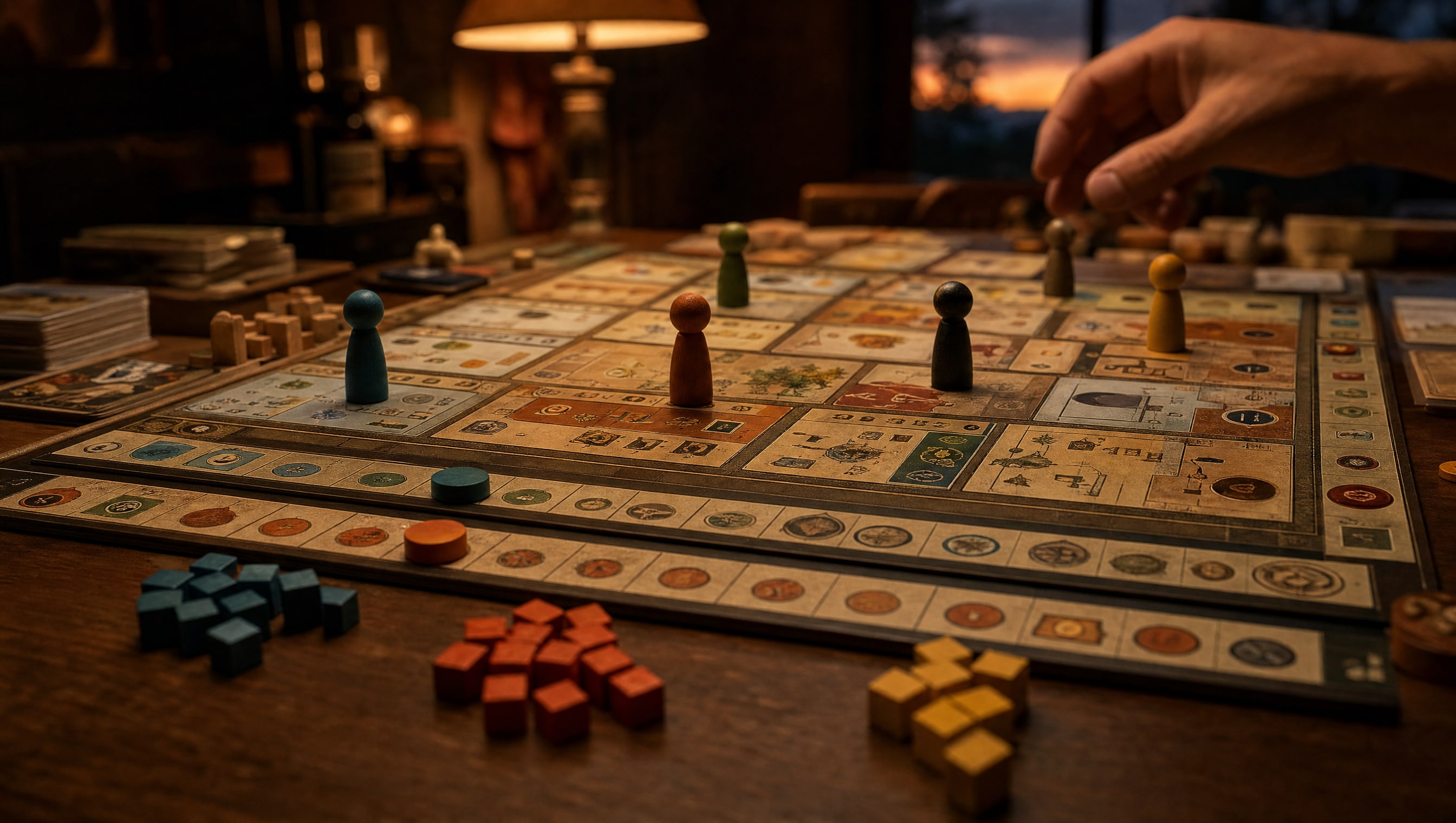
The boxes that frighten people are rarely the ones with the most rules. Wingspan runs four rounds and a page of icons and nobody drowns in it. Agricola runs fourteen rounds and has a reputation, and the difference is not page count — it is interlock. In a heavy euro the thing you take in round two decides which action is still open in round six, which is why reading the book front to back tells you almost nothing about how to play. You close it knowing every rule and no reason for any of them.
So read it in the other order. Find the scoring summary — in most euros it is one page, and increasingly it is printed on a player aid so nobody has to hunt for it mid-game — and read that first. It is not an appendix, it is the brief. Everything the rest of the book describes is a way of getting numbers into one of those boxes, and once you know which boxes exist, forty pages of actions sort themselves into two piles: feeds a box, and does not.
Then find the converter. Every engine in one of these games comes down to something that turns a thing you can get into a thing that scores — a building that eats grain and prints a point, a card that turns two cubes into three, a track that pays out every time it advances. There are usually one or two that matter, and a great deal of handsome furniture arranged around them. The step up is not learning more rules. It is learning to look at a crowded board and see the two gears that are actually in mesh.

BEFORE THE FIRST TURN
Read the scoring summary aloud, then the end trigger, then let somebody teach you setup. Three minutes, in that order. The teach that follows stops being a list of things you may do and becomes a set of routes to a number.
DURING YOUR FIRST GAME
Decide on other people's turns, and when nothing is obvious take the obvious move. Most turns in a heavy game are not decisions at all — you are hunting the three or four that are, and you cannot hunt them while re-reading a card you already understand.
WHEN IT GOES WRONG
It will, somewhere near the middle, and the instinct is to start a second plan. Finish the first one. A plan carried badly to the end shows you the exchange rate you were paying; two half-plans show you nothing except that heavy games are confusing, which you already suspected.
AFTER THE LAST TURN
Ask the winner one question — where did your points come from? You will get the whole game back in a sentence, and it is nearly always a converter you never built. Then play the same box again before you buy another one.
THE DETAIL
Draw one of these games as a gear train and it stops being complicated. Something you can get feeds a converter; the converter feeds the thing that scores. Position left to right is the order of conversion, and tooth count is the exchange rate — eight teeth on the converter against thirty-two on the score wheel is four converter turns for one turn of the score, and you can count it on the bars underneath. Everything below the second rule is the other half of every heavy board: real parts, drawn to the same scale, turning perfectly well and touching nothing. Which of them are in mesh is different in every box, and finding out is the whole of the skill.
5 PIECES · ON THE TABLE
Five pieces queued for this space. The titles are set and the drafts are moving; nothing here is linked until the page exists, because a door onto an empty room costs you a click to find out.
01
Two hours, one obvious engine, and a rulebook you can finish in a sitting. The shape of a good first box, and the three ways a bad one hides.
BY POPPY · 6 MIN
02
Where the numbers are largest, how many routes there are, and which of them you can safely ignore all game.
BY POPPY · 5 MIN
03
One question, asked of every action space on the board: does this turn a thing I can get into a thing that scores?
BY IRIS · 5 MIN
04
Analysis paralysis is not slowness, it is doing the work in the wrong window. Where to put the search so nobody notices it.
BY IRIS · 6 MIN
05
Run one engine end to end. Ship four times. Score in a category you have never scored in. First games with a job get better faster.
BY POPPY · 4 MIN
SPACE 06 / 16 · CHAPTER 03 · STRATEGY & SKILL
Every chapter in this region is a space on this board. This one is 06, and this page is the second of the three paths it prices — the heavy shelf. Strategy & Skill holds the other two, or go back to the board to roll for another chapter.