HowTo Network emblem How To: Gaming THE HOW TO CO. — EDITION 10
EXHIBIT LABEL — RETRO GAMES SHELF 06 · CASE 01

Cartridges and discs, in section.

One of these is a plastic box with a clock soldered inside it. The other is a sheet of polycarbonate with a mirror sprayed on the top, and the top is the side nobody protects. Both of them fail from the face you trust.

WHERE THE DATA SITS
15 microns under the label
WHAT HAS A CLOCK
The save cell, not the ROM
THE FIRST CHECK
The screw, then the label edge

Almost nothing here is fragile.

CASE 01 · OPENED

A cartridge survives an attic and forgets your save. A disc survives your save and dies of a biro. Neither of them fails where you have been looking.

THE CARTRIDGE

Structurally, a cartridge is close to indestructible. The shell is a couple of millimetres of ABS, the board is ordinary glass-epoxy, and the game itself lives in a mask ROM — a chip whose contents were fixed by a photographic mask at the plant and cannot be rewritten by time, damp, magnets or a dropped bag. That is why carts are still here and why so many of them still boot on the first try after thirty years in a loft.

What does not survive is the save. Any game that remembered anything kept it in static RAM, and static RAM forgets the instant the power stops, so a three-volt lithium cell was soldered to the board to keep it awake. Nobody at the factory was designing for 2026. Most of those cells are now past their working life, and a cart with a dead one plays perfectly — it simply stops remembering, usually the second time you switch it on. Replacing it is a soldering job, and it wipes whatever the old cell was still holding, which is the part people are not told first.

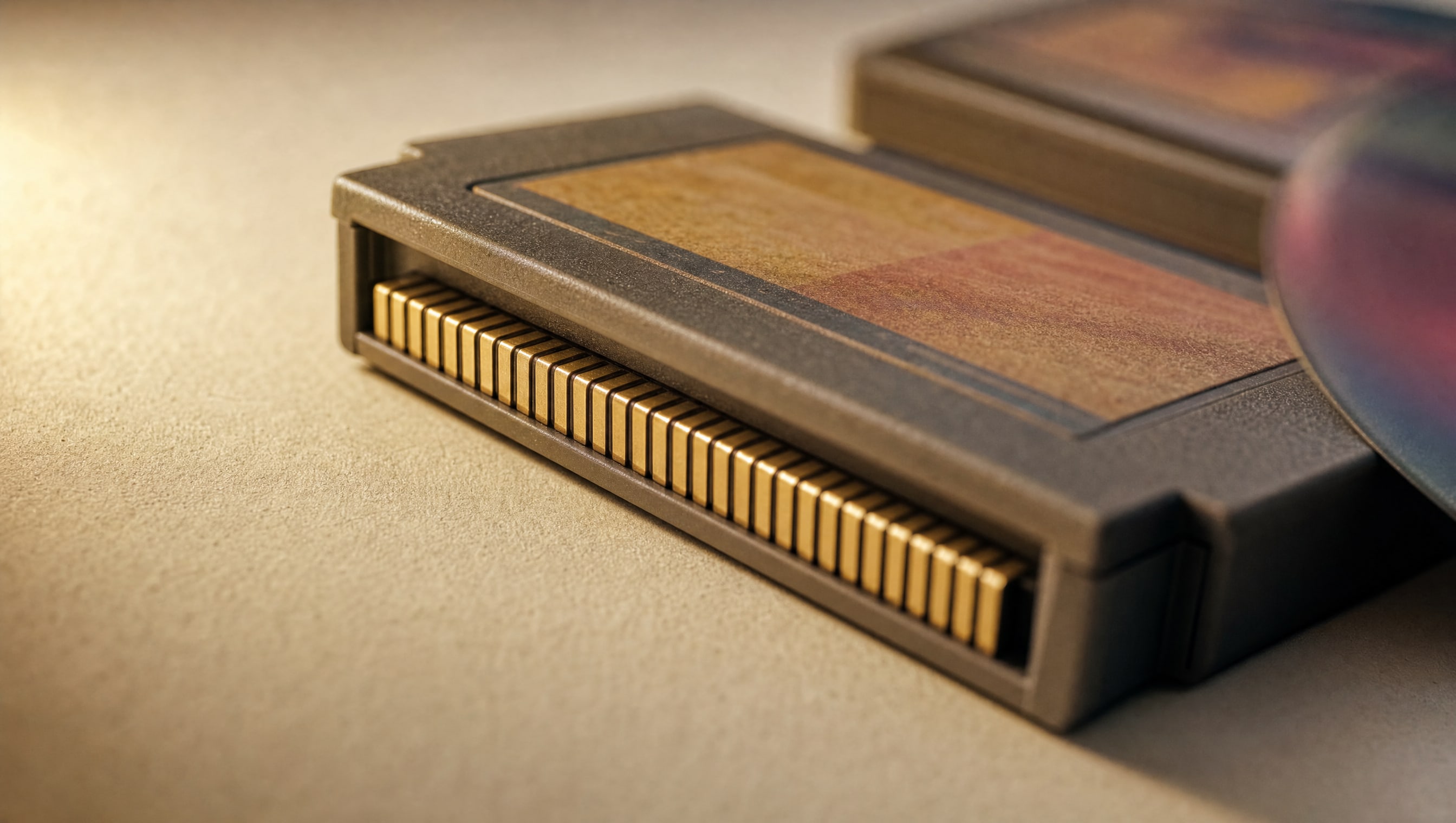
The other complaint is not damage at all. The fingers on the edge connector are hard gold about a micron thick over nickel; gold does not corrode, but a damp cupboard will film the whole strip with everything else it has. That comes off with high-strength isopropanol and a lint-free cloth, drawn along the fingers rather than across them. Never a cotton bud, which sheds. Never blowing into the slot, which is warm water vapour aimed at a contact.

THE DISC

A disc looks like a solid object and is really a stack. Under your thumb: about five microns of screen-printed label, ten microns of lacquer, then a mirror of aluminium roughly eighty nanometres thick, then a spiral of pits moulded into the top face of 1.2 millimetres of clear polycarbonate. Everything that matters is in the top fifteen microns, and it is closer to the printed side than the thickness of a sheet of kitchen foil.

Which inverts what everyone thinks they know. The shiny face is the armour: the laser has to climb 1.2 millimetres of plastic to reach the data and its beam is nearly a millimetre wide where it enters, so a fine scratch down there is badly out of focus by the time it matters. A scratch on the printed side is fifteen microns from the mirror. A ballpoint will do it. A peeled sticker has taken the mirror off with it more than once.

And the mirror has its own clock. Where the lacquer was thin, or the edge was sealed badly, air reaches the aluminium and it oxidises — bronze first, then patchy, then a disc you can read a newspaper through. It is not common and it is not universal, but it is not repairable either, and it is the one failure a perfect cupboard does not prevent. Which is the honest reason to rip a disc library you care about, and to keep the discs anyway.

Both of them, cut open.

THE DETAIL

A cartridge sectioned through its depth and a compact disc sectioned through its radius, drawn on the same sheet at the same scale. They come out almost exactly the same length, because a cart is 120 millimetres tall and a CD is 120 millimetres across, and that accident is the whole comparison: one is a box eighteen times the other’s thickness with parts in it, the other is a single moulding with nothing inside it at all. Then the disc’s top is opened twice more. At fifteen hundred times you can finally see the label and the lacquer; the aluminium mirror underneath them is still thinner than the line drawn for it, which is not a shortcut but the measurement. At twenty thousand times it is thick enough to draw, following the contour of pits half a micron wide, with the read spot laid over the top — 1.7 microns across, wide enough to cover the track it is reading and narrow enough to stop short of both its neighbours, which is the whole reason the pitch is 1.6.

TWO OBJECTS, ONE CUT BOTH SECTIONS AT ONE SCALE 01 · CARTRIDGE — SECTION 1234 1EDGE CONNECTORgold over nickel, 1 um2BOARD + MASK ROMwritten once, at the plant3SAVE CELL20 x 3.2 mm, soldered in4PAPER LABEL0.1 mm, on the outside 02 · DISC — RADIAL SECTION CENTREr 60 mm ALL 1.2 mm OF IT. THE LABEL, THE LACQUER AND THE MIRROR ARE ALL ON THAT TOP LINE. 03 · THE TOP 25 um · x1500 0510152025LABEL 5 umLACQUER 10 umMIRROR 0.08 umthinner thanits own linePOLYCARBONATEAND 1.2 mm MORE. THE LASER COMES UPTHROUGH ALL OF IT, FROM BELOW. 04 · ONE PIT · x20000 READ SPOT 1.7 umLACQUER ABOVEPIT 0.5 um WIDE, 0.11 DEEP · PITCH 1.6 umONE SPOT COVERS ONE TRACK · HENCE THE PITCH
TWO OBJECTS, ONE CUT CARTRIDGE AND COMPACT DISC IN SECTION, AT ONE SCALE SHELF 06 · CASE 01 INVENTED SHELL · CD GEOMETRY IS A PUBLISHED STANDARD 01 · CARTRIDGE — SECTION THROUGH THE DEPTH · 120 x 21 mm + EDGE CONNECTORGOLD OVER NICKELMASK ROMWRITTEN ONCE, AT THE PLANTSAVE CELL3 V LITHIUMSECURITY BOSSNOT A PHILLIPS 21 mmSHELL 2.2 mmABS, BOTH FACESBOARD 1.6 mmGLASS-EPOXY, ONE SIDECELL 20 x 3.2 mmTHE ONLY PART ON A CLOCKPLATING 1 umTOO THIN TO DRAW TO SCALELABEL 0.1 mmPAPER, ON THE OUTSIDE SHEET SCALE020 mmBOTH SECTIONS ON THIS SHEET ARE AT THIS SCALE 02 · COMPACT DISC — RADIAL SECTION · 120 x 1.2 mm · SAME SCALE 1.2 mm THICK, ALL IN CENTRE7.52358.5PROGRAM AREARADIUS, mm THICKNESS 1.2 mmONE MOULDED PIECECENTRE HOLE 15 mmCLAMP RING 26 - 33 mmDATA 15 um DOWNFROM THE PRINTED FACEDATA 1.2 mm DOWNFROM THE PLAY FACE INSETS 03 AND 04 CUT HERE, AT r = 40 mm 0510152025PRINTED LABEL5 um OF SCREEN INKLACQUER10 um, AND NO MORETHE MIRRORALUMINIUM, 0.08 um —THINNER THAN ITS OWN LINEPOLYCARBONATEAND 1.2 mm MORE BELOWTHE LASER ARRIVES FROM DOWN HERE03 · THE TOP 25 um OF THAT RIBBONMAGNIFIED x1500 · TRUE AXISMICRONS BELOW THE PRINTED FACE TRACK PITCH 1.6 umPIT 0.5 um WIDE,AND 0.11 um DEEPLACQUER CONTINUES ABOVEREAD SPOT, 1.7 um ACROSSIT COVERS THIS TRACK AND NEITHER NEIGHBOUR04 · ONE PIT, AND THE MIRROR OVER ITMAGNIFIED x20000 · SAME CUT AS 03

Five ways this case goes quiet.

SHELF 06 · WHAT FAILS, AND WHEN

None of these are dramatic and four of the five happen in the dark, in a cupboard, over years. Which is why the only useful question to ask a retro shelf is not what it is worth. It is which of these clocks it is already running on.

MEDIUMWHAT GOESTHE CLOCKVERDICT

CART

The save cell runs out.

A 3 V lithium coin cell soldered to the board keeps the save RAM awake. It is the only component in a cartridge with a working life.

THE CLOCK

Ten to twenty-five years from the plant. The game still plays; it stops remembering.

REPLACEABLEA soldering job. The swap takes the old save with it.

CART

The contacts film over.

Hard gold about a micron thick over nickel. Gold will not corrode, but the strip collects whatever a damp cupboard has to offer.

THE CLOCK

Months in the wrong room. Minutes to undo.

REVERSIBLEIsopropanol on a lint-free cloth, along the fingers.

BOTH

The label lets go.

Paper glued to the outside, which is where every identifying mark on both formats happens to live. Adhesive gives at the die-cut edge first.

THE CLOCK

Twenty years in a cupboard. Two summers in a window.

NOT REVERSIBLEA relabelled cart is a repro until proved otherwise.

DISC

The mirror oxidises.

Air reaches the aluminium through a thin patch of lacquer or a badly sealed edge. It goes bronze, then patchy, then clear.

THE CLOCK

Unpredictable. A bad pressing can go inside fifteen years.

TERMINALRip it now; the disc is the copy that is dying.

DISC

The printed side is scratched.

The data sits fifteen microns under the label and 1.2 millimetres under the play side. The shiny face is the armour, not the wound.

THE CLOCK

Instant. One biro, one peeled sticker.

TERMINALNothing polishes a hole in the mirror shut.

Macro along the exposed edge connector of an invented cartridge, the plated fingers catching warm shelf light.

The shiny side is the armour. The printed side is the wound.

POPPY — CLASS: CURATOR
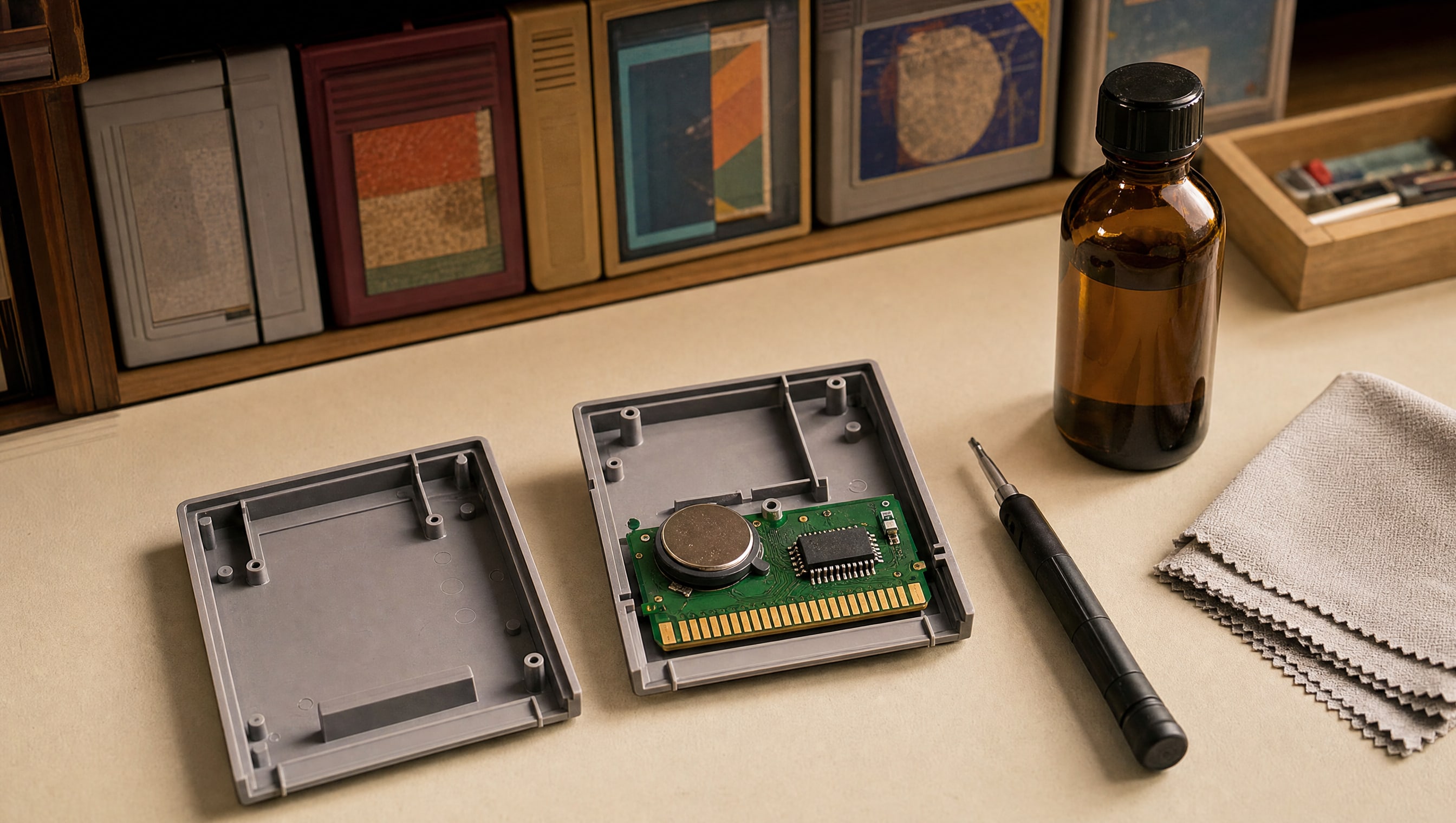
An invented cartridge opened on a bench beside a security bit, a lint-free cloth and a small bottle of isopropanol.

FROM THE CURATOR

I buy the ones I am allowed to open

A three-pound bit gets you inside almost every cartridge made before 1997, and the inside is where the honest answer lives: a genuine board is a plain, boring thing with through-hole parts and a chip that says nothing interesting, and a repro is a tidy little green square with a socket on it. I have been sold two fakes in nine years and both of them looked perfect from the front. Now I do not buy a cart I am not allowed to open in front of the seller, and the ones who say no are telling me everything I needed.

BY POPPY — CLASS: CURATOR · THEPINKPIPER.GG

What this case will hold.

5 PIECES · IN THE ARCHIVE

The pieces this case is holding room for. The first three are carried over from the day it opened; the last two answer the disc half of the plate above. Titles are set here before they are written, so the case shows its shape — nothing links yet, because a label pointing at an empty case is worse than a label that says wait.

01

How to Spot a Reproduction Cartridge

Screw head, label edge, board. The three checks in the order that settles it fastest.

GUIDE · 1300 WORDS

02

How to Store Cartridges So They Keep Working

Heat, damp, and a cell on a finite clock. Storage that keeps a save file alive.

HOW-TO · 900 WORDS

03

How to Clean a Cartridge That Won’t Load

What actually sits on the contacts, what removes it, and the two habits that make it worse.

HOW-TO · 800 WORDS

04

How to Tell Disc Rot From a Dirty Disc

Holding it to a lamp, reading the edge, and knowing when the mirror has already gone.

GUIDE · 1000 WORDS

05

How to Rip a Disc Library Before It Stops Reading

Drives that read tired discs, checksums worth keeping, and why you keep the discs anyway.

HOW-TO · 1100 WORDS

THE REST OF THIS SHELF

Retro Consoles CASE 02 →Valuing & Sealed Grading CASE 03 →

BACK TO RETRO GAMES →

You are here.

SHELF 06 / 07 · RETRO GAMES · CASE 01 / 03

01 02 03 04 05 YOU ARE HERE 06 07 RETRO GAMES. CARTS & DISCS · CONSOLES · VALUING & SEALED CASE 01 / 03 — YOU ARE READING THIS ONE
01 02 03 04 05 06 07 RETRO GAMES. CARTS & DISCS · CONSOLES · VALUING & SEALED

Every chapter in this region is a bay on this wall. This one is 06, and you are at case 01 of 03 on it — Cartridges & Discs. Back to the wall to walk the rest.