01
How to tell a set is about to retire before the shelf empties
Stock gaps, retiring flags and discount patterns — the three signs that arrive months before the last box.
BY POPPY · 8 MIN
 How To: Gaming
THE HOW TO CO. — EDITION 10
How To: Gaming
THE HOW TO CO. — EDITION 10
A set does not become rare on the day it stops being sold. It becomes unavailable, which is a different thing, and the months that follow are the ones nobody draws.
THE INTRODUCTION
Every LEGO set has an end date. The company does not publish it, but it flags sets as retiring on its own store, and the shelf itself announces it long before anyone says so out loud.
A set runs at retail for something like eighteen to twenty-four months. Display sets aimed at adults — the modular buildings, the big licensed models — often run longer; a small seasonal box can be gone in a season. Then LEGO stops making it, stops selling it, and it belongs entirely to whoever already owns one. That is the whole mechanism. There is no auction, no announcement, no bell. The shelf just thins out and then it is empty.
What follows is the part the sealed-box conversation skips, and it is the reason so many people buy at exactly the wrong moment. Retirement does not push the price up. It stops pushing it down. Through the last months the set is being discounted hard — retailers clearing stock, warehouses emptying, third-party sellers undercutting each other on a box they need gone. The cheapest a set will ever be is usually a few weeks before it disappears, not after. Then the discounting stops, the remaining stock drains over the best part of a year, and only then does the price start to walk back up towards what the set originally cost.
Draw that on a real time axis and the shape is unmistakable: a trough, a crossing, a drift. A retired set takes roughly eight months to be worth again what it cost new. Somebody who paid full price on the last day, and everybody who paid a premium in the first weeks after, spent that year underwater — and the box did nothing wrong. It was simply bought at the bottom of a curve that had not turned yet.
Over longer periods the drift is real. A published study of three decades of secondary-market prices put the average return on retired sets at somewhere around eleven per cent a year — a genuine number, and a badly misread one. An average is not a typical outcome when the spread is this wide. A minority of sets carry almost all of it. A large share go essentially nowhere: they come back to what they cost, sit there, and stay there while the shelf they are on earns nothing. This page is about telling those two groups apart before the money moves, not about treating a plastic box as a savings account.
THE CALENDAR
Nobody loses money on a retired set because they picked the wrong one. They lose it because they bought at the wrong point on this line, and the line is never drawn for them.
-18
In production
Full shelf, full price. Nothing about the box says it has an end date, because nothing has been announced.
-9
The last call
The shelf stops being refilled. Gaps open, the retiring flag goes up, and the discounting starts.
-2
The trough
Clearance. Everyone undercuts everyone on a box they need gone. The cheapest it will ever be.
0
It leaves retail
The last box goes. Nothing jumps — the discounting simply stops and the remaining stock drains.
+8
Back to what it cost
The crossing. Anyone who paid a premium in the first weeks after spent this year underwater.
+72
The long drift
Six years on the median has moved, and a minority of sets has carried nearly all of the average.
SIX STATIONS IN THE ORDER THEY ARRIVE · NOT TO SCALE — THE PLATE BELOW CARRIES THE TRUE TIME AXIS
THE DETAIL
Two quantities, one linear month axis, stacked rather than laid over each other — availability and price are different units and drawing them on a shared vertical scale would invent a relationship. Above: new sealed stock at retail, as a share of peak shelf presence. Below: the secondary market, indexed so that what the set cost new is one hundred. Both scales start at zero. The curves are the shape of a retirement, not one set’s ledger, and the band is drawn because the spread is the thing being decided.
SUPPLY · CONDITION · THE HOLD
Scarcity is not a mood. It is a supply question with a boring, checkable answer: how many sealed boxes still exist, and how many people want one. Four things move that number, and none of them is how good the set looks.

01
WHO BOUGHT IT, AND WHY
The sets that get genuinely scarce are the ones adults bought to build. A large display model is opened by almost everybody who buys it, so sealed supply is thin for real. A set every reseller stacked ten deep in a garage has a hidden warehouse behind it, and that warehouse opens the moment the price moves.
02
WHETHER IT COMES BACK
LEGO re-makes its own subjects. A castle, a fire station, a famous ship — the theme retires and a successor arrives doing the same job, in current parts, at current prices. A licence that has lapsed cannot be re-made, and that is the difference between a closed supply and a paused one.
03
THE BOX IS THE ASSET
Sealed means the box, not the bricks. Sharp corners, no shelf rash, no price-sticker scar, no bowed panel, factory flaps intact. Two identical sets in different condition are not the same object, and the gap between them is wider than most of the drift the curve above is drawing.
04
SHRINK-WRAP PROVES NOTHING
LEGO seals most boxes with glued flaps, not plastic film. Wrap on a box is usually a seller’s addition — it hides damage, traps humidity against printed card, and crushes corners when stacked. Verify the flaps. A film you cannot see through is not a guarantee; it is a curtain.
| WHAT IT IS | TIME ON SHELF | WHAT HAPPENS TO SEALED SUPPLY |
|---|---|---|
| Modular / adult display set | 2–3 YEARS | Bought to be built, and nearly all of them are. Thin sealed supply that stays thin, because a second copy was never the point. |
| Large licensed model | 18–30 MONTHS | Depends entirely on the licence. If it lapses, nothing replaces the set; if it renews, a new version arrives and the old box becomes the older box. |
| Convention or promo exclusive | WEEKS | The run is genuinely small and the demand is known on day one, which is why the price moves before it retires rather than after. |
| Evergreen City or Classic box | YEARS, THEN REPLACED | Retires into a successor doing the same job. Enormous production, endless supply, and no gap for the price to move into. |
| The set everybody stacked | 18–24 MONTHS | Scarce on paper, warehoused in practice. Every rise brings sealed stock back out of storage and puts the lid straight back on. |
THE HOLD
Then there is the cost of holding, which no curve shows. A sealed box occupies shelf that could hold something built. Cardboard fades — reds and yellows go first, and a window of afternoon sun will do more damage in two summers than a decade in a cupboard. Heat loosens glue, damp lifts print, and thirty years does quiet work on the rubber and the sticker sheets inside. Flat, dark, dry, off the floor, and not stacked so high the bottom box bows. That is the whole preservation plan, and it is the only part of this page anyone can actually control.
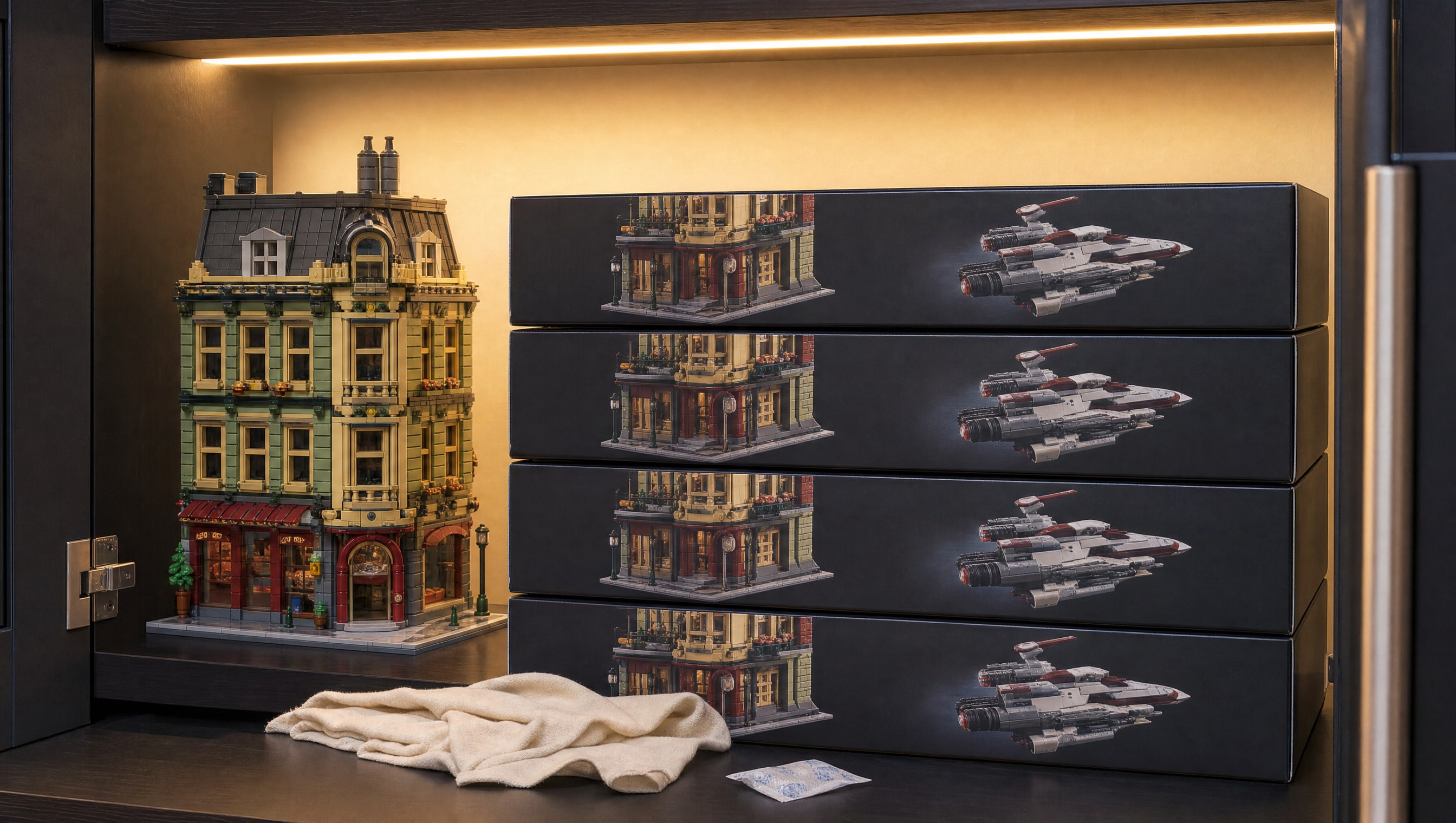
5 PIECES · IN THE ARCHIVE
The archive behind this label. Titles are set and the pieces are being written — nothing here links yet, because a label pointing at an empty case is worse than a label that says wait.
01
Stock gaps, retiring flags and discount patterns — the three signs that arrive months before the last box.
BY POPPY · 8 MIN
02
Where the trough sits, when the crossing happens, and how to spot a chart drawn from four sales.
BY POPPY · 7 MIN
03
Factory flaps against reseller film, corner wear, sticker scars, and what a bowed panel is telling you.
BY IRIS · 6 MIN
04
Flat, dark, dry and off the floor — plus the two rooms in most houses that will quietly ruin it.
BY POPPY · 5 MIN
05
Used-complete against sealed, what a missing piece really costs, and when the seal is not worth the premium.
BY IRIS · 6 MIN
SHELF 05 / 07 · LEGO · CASE 03 / 03
Every chapter in this region is a bay on this wall. This one is 05, and you are at case 03 of 03 on it — Retired Sets. Back to the wall to walk the rest.