01
How to strip a factory paint job without crazing the plastic
Which solvent for which plastic, the underside-of-the-base test, and when to stop and leave the paint on.
BY POPPY · 8 MIN
 How To: Gaming
THE HOW TO CO. — EDITION 10
How To: Gaming
THE HOW TO CO. — EDITION 10
A repaint is not a colour decision. It is a thickness decision, made four times, and the lines cut into the sculpt underneath are only a hundred and fifty microns deep.
THE INTRODUCTION
Wash, prime, base, detail, seal. Nothing in that list is optional and nothing in it can be swapped — and every step is a decision about how much film goes on.
A figure leaves the factory wearing a trace of mould release, and it is invisible. Paint laid straight over it looks perfect for a month and then lifts off in sheets, usually from the one edge you handle. So the first thing that happens to a customized figure is warm water, dish soap and a soft brush, then a full day standing somewhere dust-free to dry. Anything that unclips — arms, hair pieces, a cape, the peg — comes off now rather than being masked around later.
Then primer, and primer is the step people skip because it does not look like progress. Acrylic does not bond to PVC or resin; it bonds to primer, which grips the plastic mechanically and gives the coat above it something to hold. Two light passes from a hand's length away, each one so thin it looks like a mistake, beat one wet pass every time — a wet pass runs into the low points of the sculpt, and the low points are the sculpt. Grey under most colours, white under yellows and reds, black only when you want the whole piece to sit down in shadow.
The base coat is the same discipline three times. Thin to about the consistency of milk, lay it down, let it flash off, do it again. Each coat should look inadequate on its own. Three thinned coats give a flatter, tougher, thinner film than one straight from the pot, and they leave the panel lines open — which matters, because the next step needs them.
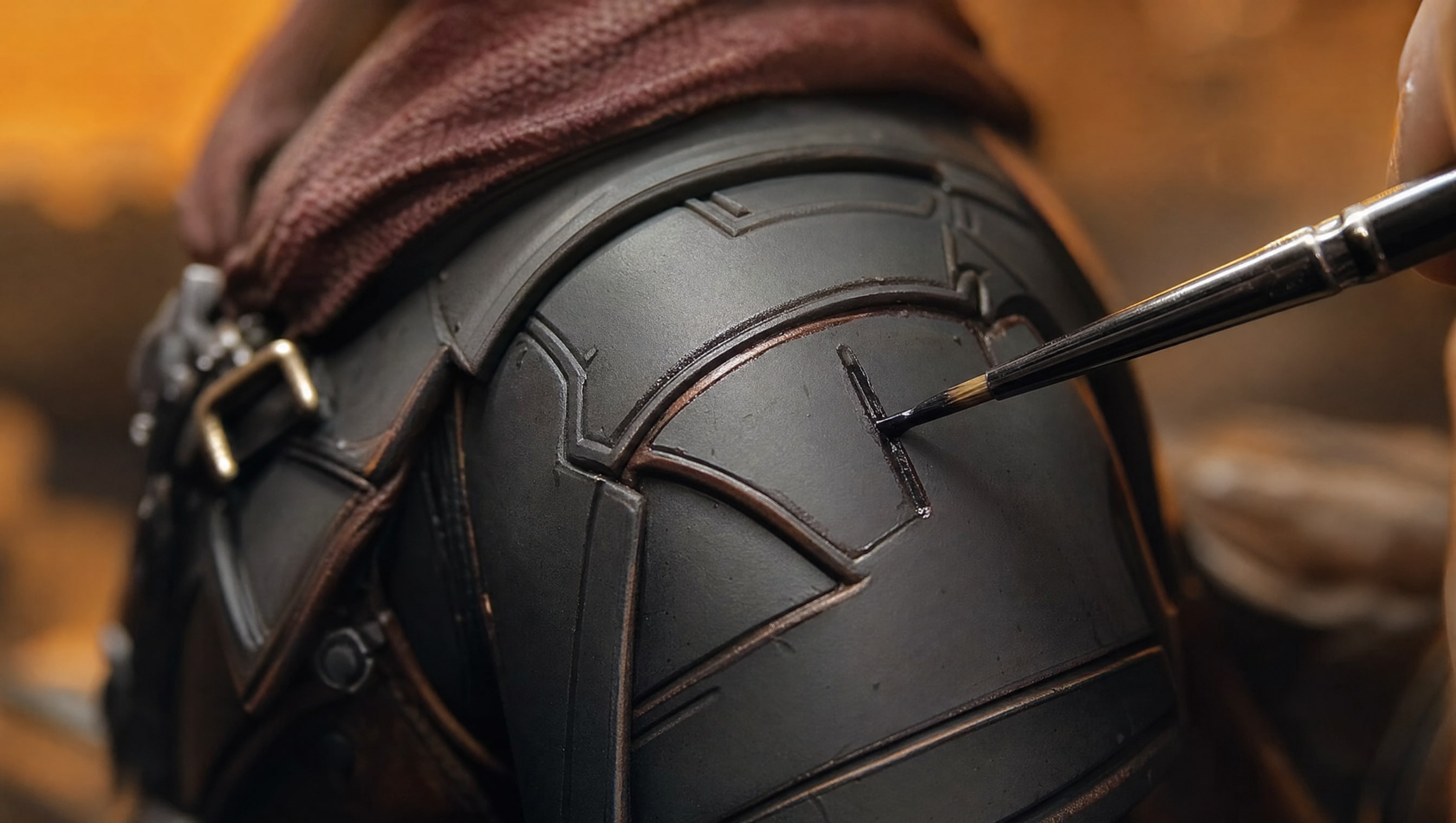
Detail is where the sculpt does the work for you. A thinned dark wash run into the recesses finds every line the sculptor cut and stays there; a nearly dry brush dragged across the raised edges catches them and nothing else. Neither adds meaningful film. That is the point: the two techniques that make a repaint look expensive are the two that put almost nothing on the figure.
Then the seal, which is thicker than anyone expects — a matte varnish in two light passes is the second heaviest thing on the piece. Matte over the whole figure, then gloss brushed back in only where the object should look wet: eyes, lips, a blade, anything metal. Varnish is also the point of no return. Everything before it can be taken back off with a solvent and a cotton bud; after it, stripping means taking the whole stack down to bare plastic. Test whatever you strip with on the underside of the base first, where nobody will ever look.
THE DETAIL
Nobody wrecks a figure with the wrong colour. They wreck it with film. A repaint done properly is four layers and seventy-seven microns of dry paint, standing on a sculpt whose panel lines, hair partings and lash lines are cut a hundred and fifty microns deep — so a good repaint spends about 51 per cent of the line and leaves the rest of it open. Three coats straight from the pot lay down a hundred and fifty microns on their own, exactly as much film as one of those lines is deep, and the line simply closes.
THE ORDER OF OPERATIONS
The same run as the plate above, read along time instead of depth. Under every gate is how much of that 150 µm cut has been spent by the time you leave it — and the first gate is the only one that spends nothing, because it is the only one that takes something off.
01
TAKES SOMETHING OFF
Warm water, dish soap, a soft brush, then a day drying. The mould release it lifts is invisible, and paint laid over it peels a month later.
NOTHING ON THE SURFACE · NONE OF THE CUT SPENT
02
+15 µm
Two light passes from a hand’s length away. Acrylic grips primer, not plastic — and one wet pass floods the low points, which are the sculpt.
15 µm ON THE SURFACE · 10% OF THE CUT SPENT
03
+36 µm
Thinned to milk, three times, each coat looking inadequate alone. The heaviest step here, and still lighter than one coat straight from the pot.
51 µm ON THE SURFACE · 34% OF THE CUT SPENT
04
+8 µm
A wash run into the recesses, a dry brush dragged over the raised edges. The two moves that read as expensive add almost nothing.
59 µm ON THE SURFACE · 39% OF THE CUT SPENT
05
+18 µm · POINT OF NO RETURN
Two light passes of matte varnish, and the door shuts. Everything before this comes off with a solvent; after it, only stripping does.
77 µm ON THE SURFACE · 51% OF THE CUT SPENT
THE SAME FIVE GATES, PAINTED STRAIGHT FROM THE POT
150 µm IN THREE COATS · THE CUT IS FULL · THE LINE CLOSES
WHAT ACTUALLY GOES WRONG
None of these is a mistake anyone makes on purpose, and none of them looks like a mistake while it is happening. All four are avoidable in the ten seconds before the step that causes them.
5 PIECES · IN THE ARCHIVE
The archive behind this label. Titles are set and the pieces are being written — nothing here links yet, because a label pointing at an empty case is worse than a label that says wait.
01
Which solvent for which plastic, the underside-of-the-base test, and when to stop and leave the paint on.
BY POPPY · 8 MIN
02
Washing off the mould release, two light passes instead of one wet one, and choosing the primer colour.
BY POPPY · 6 MIN
03
Mixing to milk, letting each coat flash off, and reading the sculpt to know when the next one is too many.
BY IRIS · 5 MIN
04
The two techniques that make a repaint look expensive, and why neither adds any film worth measuring.
BY POPPY · 7 MIN
05
Why varnish blooms, the weather it happens in, and where gloss is allowed back on the figure.
BY IRIS · 5 MIN
SHELF 01 · CASE 03 / 03 · CUSTOMIZING
Every chapter in this region is a bay on this wall. Bay 01 is Figures & Statues, and this page is the third of the three cases standing inside it. Back to the wall to walk the rest.