01
How to work out what a shelf span will actually hold
The cube rule, where to put the supports, and the lipping that beats a thicker board.
BY POPPY · 7 MIN
 How To: Gaming
THE HOW TO CO. — EDITION 10
How To: Gaming
THE HOW TO CO. — EDITION 10
A case is two numbers, and the one that decides everything is invisible at the point of purchase: how many moves stand between your hand and the piece.
THE INTRODUCTION
Three decisions, and only the first one is cheap to change afterwards. Everything a display case does well or badly it was already doing on the day you measured the wall.
Start with depth, because depth is the decision that quietly sets how much of the collection you will ever look at. A 180 mm figure standing on the front edge of a 300 mm deck leaves room for a second row, and a second row is a real gain — roughly a third more pieces on the same frontage. On a 450 mm deck it leaves room for a third row that nobody will ever see. Depth past the second row is storage. If the wall is only going to hold one unit, buy the shallower one and buy two of them.
Then the shelf itself, which is the part people trust and should not. A deck bends under load in proportion to the cube of its span: put the same total weight on a shelf twice as long and it sags eight times as far. That is why a 900 mm span of 18 mm melamine-faced board holds a row of figures for a year and then holds a visible smile in the middle of it, and why the fix is almost never a thicker board. Bring the supports in, or glue a 20 mm lipping along the front edge — a strip on edge does far more for stiffness than the same timber laid flat.
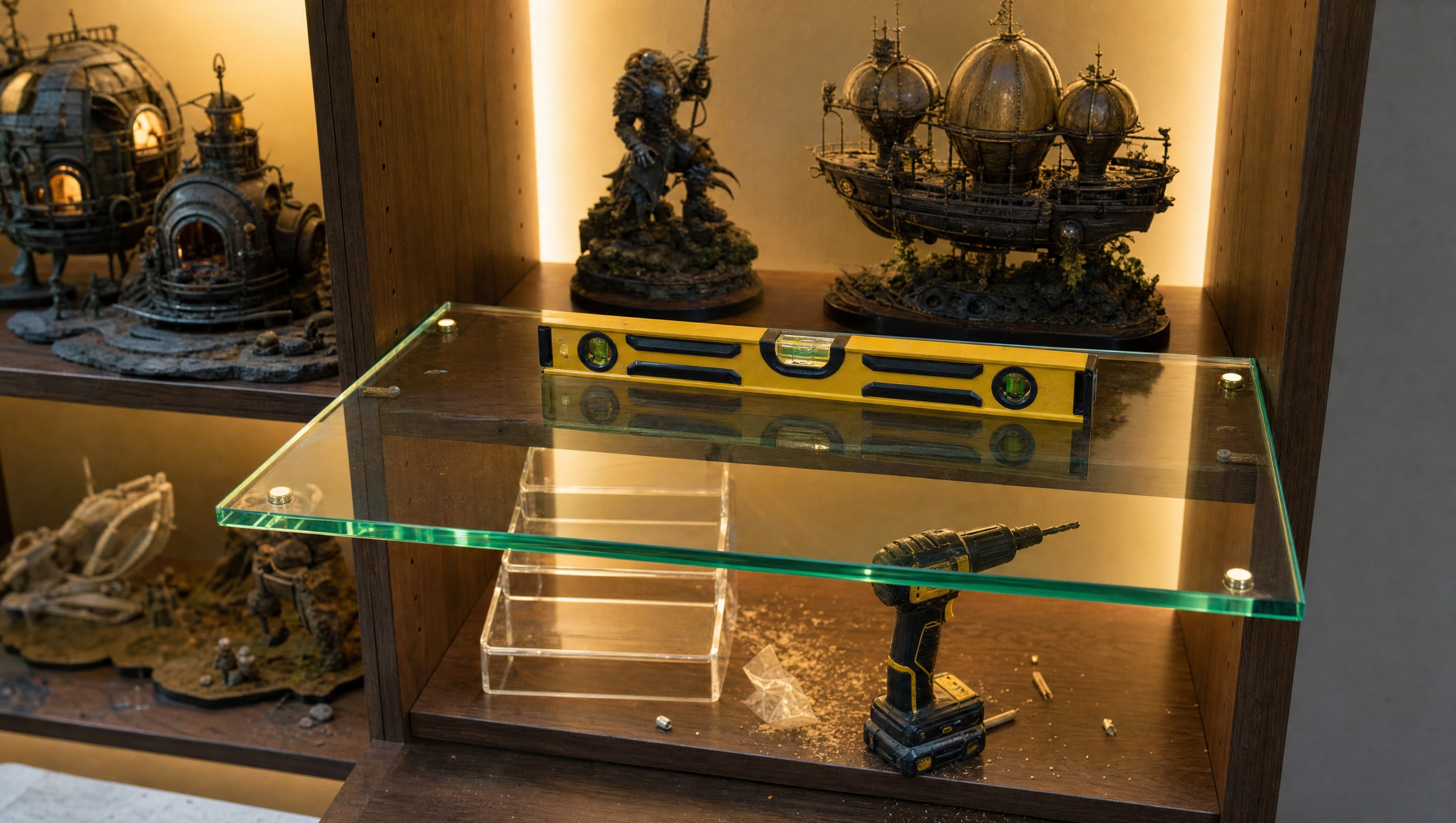
Glass shelves are the ones to check rather than assume. Four millimetre float glass weighs 10 kg for every square metre of it before anything is put on top, and it is annealed, which means that when it does go it goes into blades. Six millimetre toughened, supported at both ends over a short span, is the honest minimum for anything you would be upset to sweep up. Acrylic is a third of the weight and none of the stiffness — a 3 mm acrylic deck at 800 mm will bow under its own contents in a warm room, and it holds a static charge that pulls dust onto it faster than the glass beside it.
Closure is the decision the drawing below is about. Every door you add buys a deck that stays clean and charges you the same toll on every visit: a latch, a swing, and only then the reach. One move becomes three. That sounds trivial written down and is not — it is the difference between a collection you rearrange on a Tuesday evening and one you photograph twice a year. Be honest about which of those you are, and buy the case that matches the honest answer rather than the flattering one.
Height comes last because it is the one that ambushes people. A deck below your eye line shows its back row for free; a deck above it hides the back row behind the front one, and the riser needed to bring it back grows at a fixed rate the higher you go. Above your own eyes the riser ends up taller than the figures standing on it, which is the point at which the top of a unit stops being display and becomes a shelf you own.

THE DETAIL
The same collection, offered three pieces of furniture, drawn to one scale on one floor with an eye line at 1550 mm across all three. Under each unit are the only three numbers worth comparing at the point of purchase: the run of deck edge it gives you, the floor it takes to give it, and the number of separate moves between your hand and a piece standing on it. Read them together and the trade is unmissable — every deck closed against dust costs exactly two more moves, and the unit that takes no floor at all pays for it in frontage and in height.
THE RISER
A riser is not a decoration and it is not a guess. Stand 900 mm back from the shelf with your eyes at 1550 mm, and the line that grazes the top of the front figure is the line the back one has to be lifted to. Everything below is that line, answered for five decks up one wall.
2000 MM
292MM RISER
1600 MM
221MM RISER
1200 MM
150MM RISER
800 MM
79MM RISER
400 MM
8MM RISER
The rate is 71 mm of riser for every 400 mm you go up the wall, and it does not care how tall the figures are — it is the ratio of the back row’s offset to how far back you stand, and nothing else. Which is why the top deck is the one to watch: at 2000 mm the riser has to be 292 mm, taller than the 180 mm figure standing on it. That is the line marked through every bar above, and the deck that crosses it is the deck where a second row stops paying for itself.
MATERIAL & SPAN
Two questions, and the second one is arithmetic. What the deck is made of decides how it fails; how far it reaches between supports decides when.
10.0 KG PER M², BEFORE ANYTHING STANDS ON IT
15.0 KG PER M², AND THE ONE TO BUY
3.6 KG PER M², AND NONE OF THE STIFFNESS
×1
450 MM SPAN
Two supports close in. Almost anything holds this: chipboard, 4 mm glass, acrylic.
×2.4
600 MM SPAN
A third longer, and it already bends more than twice as far under the same total load.
×8
900 MM SPAN
Twice the reach, eight times the sag. Bring the supports in or lip the front edge — a thicker board is the expensive way round.
5 PIECES · IN THE ARCHIVE
The archive behind this label. Titles are set and the pieces are being written — nothing here links yet, because a label pointing at an empty case is worse than a label that says wait.
01
The cube rule, where to put the supports, and the lipping that beats a thicker board.
BY POPPY · 7 MIN
02
Weight per square metre, how each one fails, and the static charge nobody mentions.
BY IRIS · 6 MIN
03
One sightline, five decks, and the height at which a second row stops paying for itself.
BY POPPY · 5 MIN
04
Hinges, seals and magnetic catches, and what the two extra moves cost you in practice.
BY IRIS · 6 MIN
05
Deck pitch, sightlines and the run of frontage that makes seven units look deliberate.
BY POPPY · 8 MIN
SHELF 04 · CASE 01 / 03 · SHELVES & CASES
Every chapter in this region is a bay on this wall. Bay 04 is Display & Care, and this page is the first of the three cases standing inside it — the furniture, chosen before there is anything to light or to keep the dust off. Back to the wall to walk the rest.