01
How to light a display case without fading what is in it
Where to put the strip, what 150 to 300 lux actually looks like, and the timer that does most of the work.
BY POPPY · 8 MIN
 How To: Gaming
THE HOW TO CO. — EDITION 10
How To: Gaming
THE HOW TO CO. — EDITION 10
An LED strip will not cook a figure — at any distance you would actually choose, it lifts the paint about a tenth of a degree. What it does is fade it, slowly, in dose.
THE INTRODUCTION
Every collector asks the same question about display lighting, and it is the wrong one. The right question is not how warm the strip runs. It is how many lux land on the paint, and for how many hours a day.
A white LED makes its light by firing a blue emitter through a phosphor, and almost nothing it emits falls outside the visible band. The waste heat goes backwards — into the board, through the thermal adhesive, into the aluminium channel, out to the air. Very little of it travels forward with the beam. Run the arithmetic for an ordinary warm-white tape and a figure standing 340 mm below it sits about 0.10 °C above the room. A museum environmental specification will let an object swing ±2 °C over a day; the same figure in direct sun behind glass can gain 18. The strip is not in the conversation.
What the light does instead is bleach. Photochemical fading is cumulative and it does not repair: every lux-hour a pigment absorbs is spent permanently, and the damage is the product of intensity and time. That is why conservators do not talk about brightness at all. They talk about annual exposure, in lux-hours, and for moderately light-sensitive material — dyed fabric, printed card, painted vinyl and resin — the working allowance is about 600,000 lux-hours a year, at a display level of 150 to 300 lux.
Those two numbers are the whole of it, and they are settled by two things you control. The first is distance. A strip under a shelf is a line source, not a point, so its light does not fall away as fast as the inverse-square law people quote — but it falls away hard enough that 307 mm and 498 mm are the difference between the top and the bottom of the museum range. The plate below is that curve, drawn from one real fixture.
The second is the switch, and it is the one that decides the outcome. At the top of the band, a shelf left on twelve hours a day spends its entire year's allowance by 16 JUNE. The same shelf on a four-hour timer never reaches it. Nothing about the fixture changed; a two-pound mechanical timer did the conservation work.
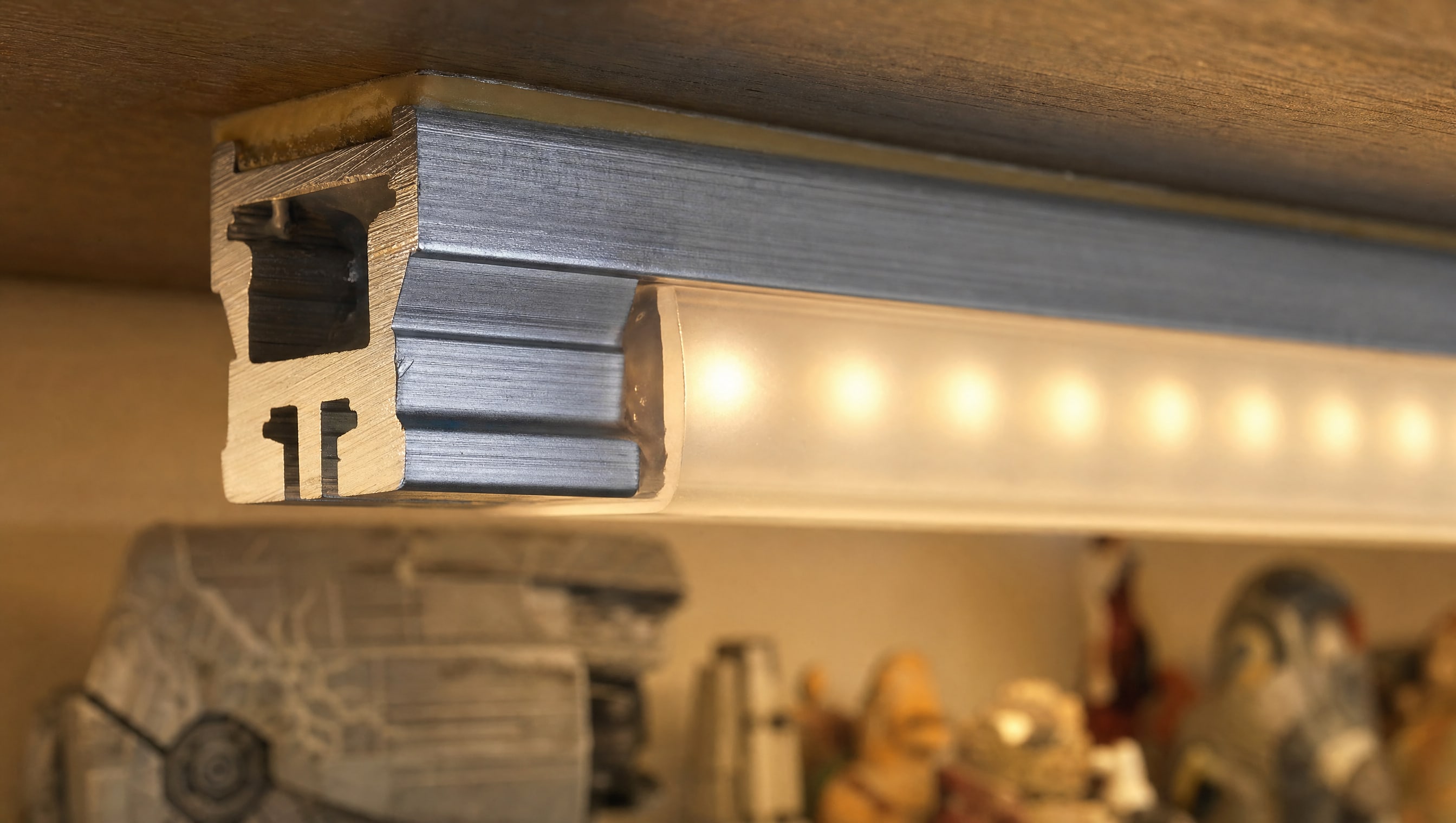
Everything else is craft. Put the tape in an anodised aluminium channel — the channel is the heatsink, and bare tape stuck to a plastic shelf has nowhere to send its heat, so the adhesive creeps, the phosphor ages early and the colour drifts within a year. Diffuse it, so the reader sees an even bar of light instead of a row of dots reflected in the glass. Aim it down the back of the case rather than out through the front, so the light lands on the object and not on the viewer. And buy the colour once: 2700 K to 3000 K for warmth, CRI 95 or better, and an R9 above 50 — R9 is the deep-red index, it is the one number cheap tape does not publish, and it is the number that decides whether a red cloak reads as red or as brown.
THE DETAIL
One strip, one true distance axis, two quantities plotted against it. Illuminance leaves the top of the frame at 120 mm and is down to 111 lux at 600 — which is why 307 to 498 mm is a real control and not a rule of thumb. Temperature rise is drawn on the same distances, and its axis is scaled to the museum's own daily tolerance of ±2 °C rather than to the curve: 1.04 °C at the edge of the contact band, 0.10 °C at the deck, and direct sun through glass off the top of the frame at +18. Under the axis, on the same ruler, is the gap itself — and a figure standing in it takes 760 lux at the head against 261 at the feet, which is 2.9 times the dose on the part everybody looks at first.
THE DOSE LEDGER
The same case, lit to 300 lux — the top of the band the plate above shades — and left on for four different numbers of hours. Every bar is measured on one ruler, and the rule crossing all four is the museum's annual allowance for this kind of material. Distance sets the rate. The switch decides whether the year is survivable.
THE SWITCH BY THE DOOR
1,314,000 LX·H · 219% OF THE ALLOWANCE · SPENT BY 16 JUNE
HOME FROM WORK UNTIL BED
876,000 LX·H · 146% OF THE ALLOWANCE · SPENT BY 7 SEPTEMBER
TWO BLOCKS, PLUG-IN TIMER
438,000 LX·H · 73% OF THE ALLOWANCE · NEVER SPENT
A PUSH SWITCH, NOT A HABIT
219,000 LX·H · 37% OF THE ALLOWANCE · NEVER SPENT
WHAT ACTUALLY HAPPENS
None of these is a fire, and none of them is visible on the day it starts. Three are decided at the shop; the fourth is decided every evening for a year.

5 PIECES · IN THE ARCHIVE
The archive behind this label. Titles are set and the pieces are being written — nothing here links yet, because a label pointing at an empty case is worse than a label that says wait.
01
Where to put the strip, what 150 to 300 lux actually looks like, and the timer that does most of the work.
BY POPPY · 8 MIN
02
Why R9 is the index that matters for painted figures, and what an 80-CRI strip does to a red cloak.
BY POPPY · 6 MIN
03
Routing the groove, seating the diffuser, hiding the feed, and why the aluminium is not decoration.
BY IRIS · 7 MIN
04
Constant-current against pulse-width, the frequency a phone camera can live with, and testing it before you fit it.
BY IRIS · 5 MIN
05
Getting a lux reading you can trust, where to hold the sensor, and turning it into a year of exposure.
BY POPPY · 6 MIN
SHELF 04 / 07 · DISPLAY & CARE · CASE 02 / 03
Bay 04 is Display & Care, and this page is the middle of the three cases standing inside it: the furniture is chosen in case 01, lit here in case 02, and defended from dust and daylight in case 03. Back to the wall to walk the rest.