01
How to sit on your hands for a whole four-second roll
The pause between a child seeing the dice and naming the number is where the counting lives. Practical ways to survive it at a table of impatient adults.
BY POPPY · 5 MIN
 How To: Gaming
THE HOW TO CO. — EDITION 10
How To: Gaming
THE HOW TO CO. — EDITION 10
Counting, patience and losing are not bolted onto a family game. They are what a turn is made of, and every one of them can be undone by a grown-up being helpful.
THE THING NOBODY PRINTS ON THE LID
A game that stops to test you is a worksheet wearing a hat.
Every few years somebody sells a family a box with a mortarboard on the front: forty questions about fractions with a spinner bolted to the side. Children work it out in about four minutes. The moment a game pauses to check whether you learned the thing, the playing stops and the quiz starts, and no child has ever mistaken one for the other.
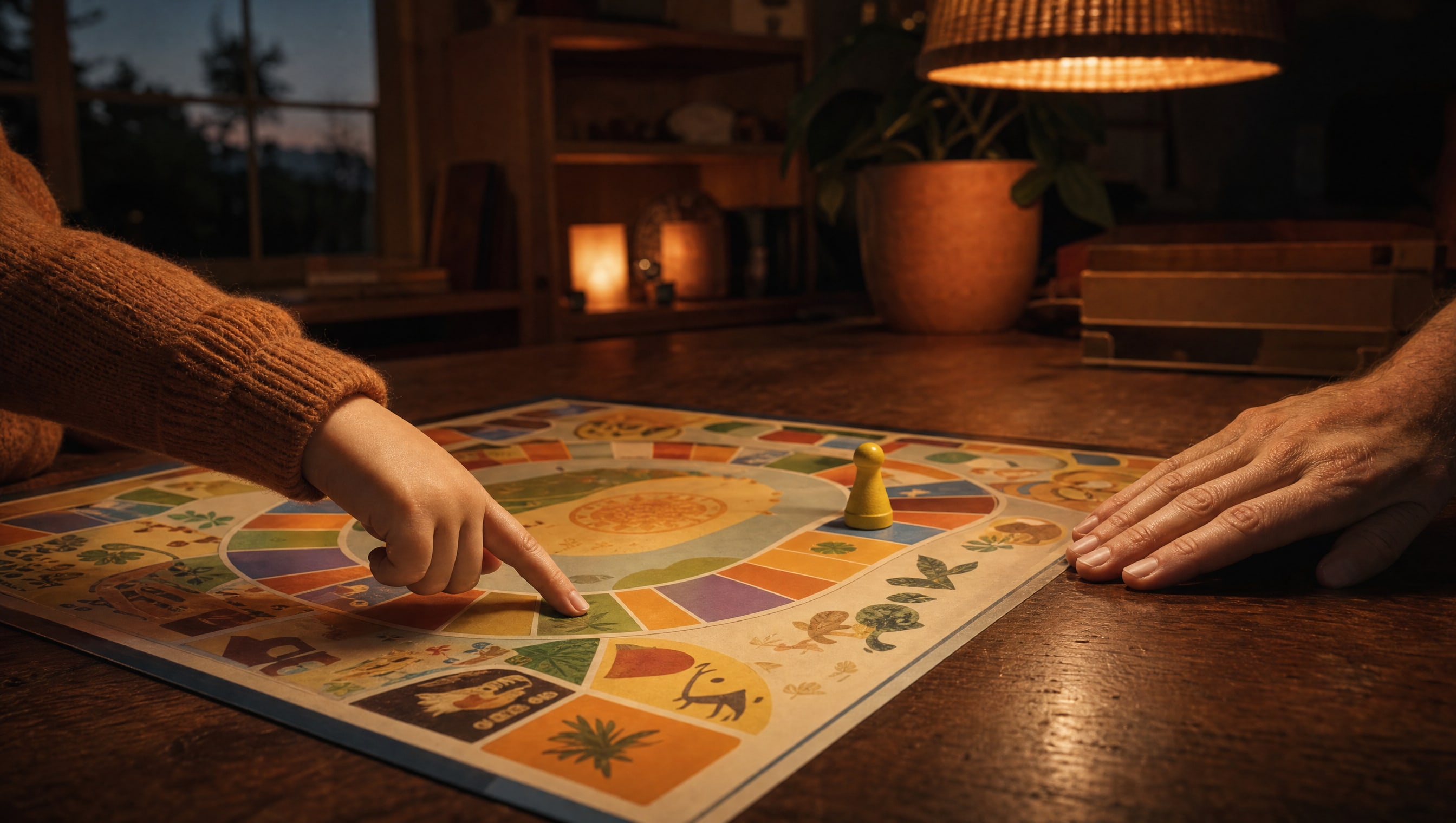
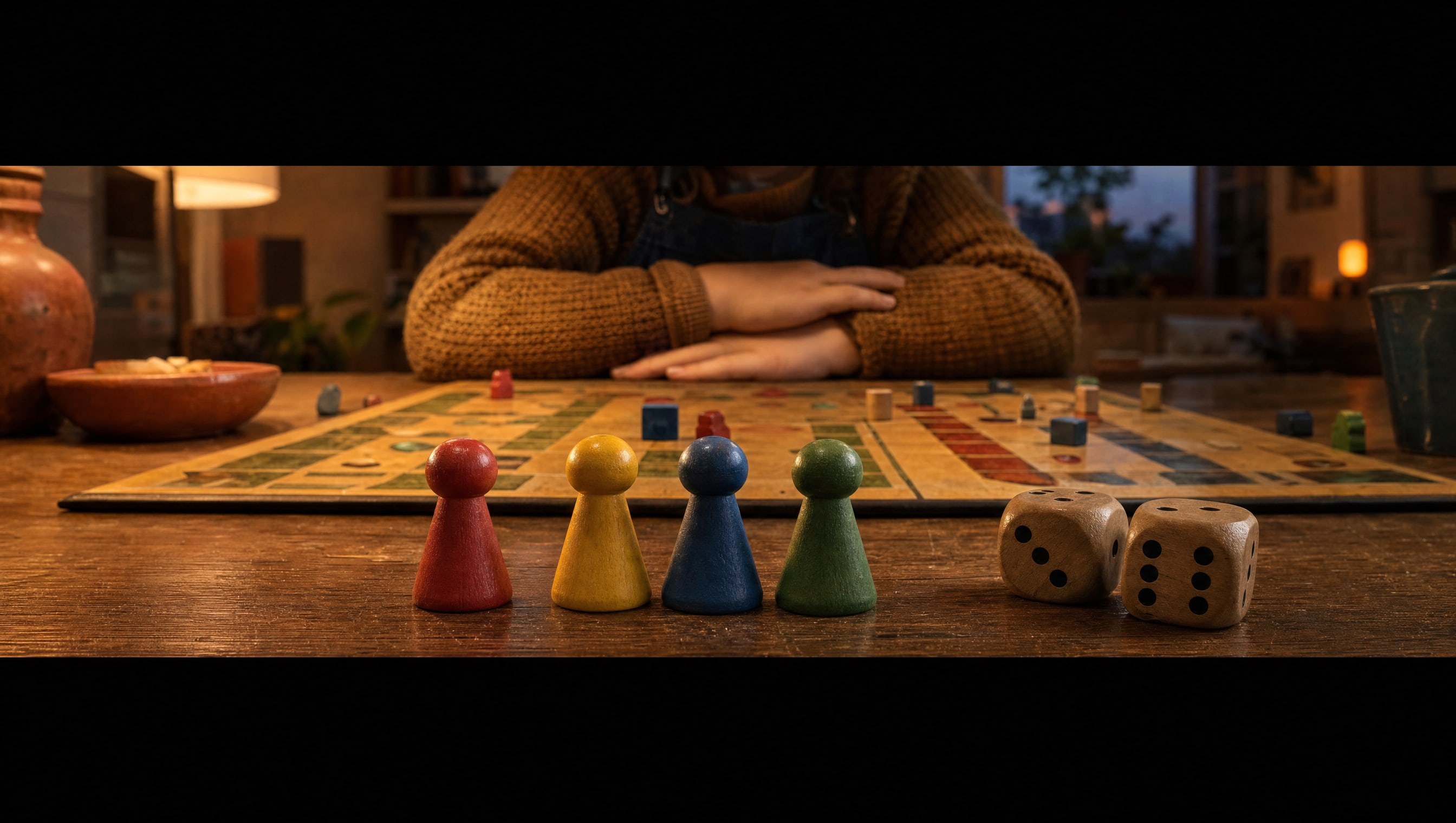
The games that actually teach never bring it up. Take an ordinary roll-and-move off a family shelf and cut one turn open. Wait, while three other people go. Roll, and read the number without being told what it is. Count that many spaces, out loud, one at a time, in front of everybody. Read what the space says. Pay what it costs, which means taking one number away from another with the table watching. Then take whatever the board just did to you without leaving the room.
That is six things and only one of them is the game. Play 14 turns of it — four players, a box that runs 29:52 — and a seven-year-old has done 4:54 of arithmetic nobody asked them to do, and 22:24 of sitting still while somebody else has the dice. There is no worksheet in the country that gets that, because a worksheet has to ask.
Which leaves the hard part, and the hard part is yours. Three seconds into a four-second step, an adult reads the dice out loud. Two spaces into the counting, an adult slides the piece along to keep things moving. At the cost, an adult does the subtraction because the child is slow and the table is waiting. Each of those is the lesson, lifted out and performed by somebody who already knows it. The hatched steps on the drawing below are the three that get taken.
The whole method is one line long. Never say the number.
THE DETAIL
Time runs down the page in real seconds. Left of the cut is the turn as it is played, each step as deep as it is long — which is why waiting is the tallest thing on the page. Right of the cut is what the turn deposits: a block appears in a skill's column wherever a step exercises it, so a column's height is that skill's seconds and nothing else. Add the columns down and you get the numbers under them; multiply by 14 turns and you get what a single half-hour box does to a child in an afternoon. The three hatched steps are the ones a grown-up takes over, and they are, between them, all of the arithmetic.
5 PIECES · ON THE TABLE
What this path is holding room for. Nothing here is a link yet — these are the pieces being written for this space.
01
The pause between a child seeing the dice and naming the number is where the counting lives. Practical ways to survive it at a table of impatient adults.
BY POPPY · 5 MIN
02
Out loud, one space at a time, wrong twice, corrected by nobody. What to do with the miscount that lands them on the good square.
BY POPPY · 6 MIN
03
Tokens before numerals, a running pile before a running total, and the week you take the pile away.
BY IRIS · 6 MIN
04
Thrown games get caught every time. Pick the box where the odds already lean their way and lose it honestly instead.
BY IRIS · 7 MIN
05
Four questions to ask a box in a shop, none of which involve the word educational.
BY POPPY · 5 MIN
SPACE 09 / 16 · CHAPTER 04 · FAMILY & KIDS
Every chapter in this region is a space on this board. This one is 09. Back to the board to roll for another.