01
How to change a rule mid-game without losing the table
The three sentences that turn a ruling back into a rule, and the one case where you finish as printed and fix it afterwards.
BY POPPY · 5 MIN
 How To: Gaming
THE HOW TO CO. — EDITION 10
How To: Gaming
THE HOW TO CO. — EDITION 10
Every family plays a different game from the one in the box. What decides whether that is a house rule or a fight is how far back the change reaches — and therefore who has to agree to it, and when.
THE SECOND DRAFT
The rulebook is a first draft. Your table wrote the second one years ago.
Almost every long-running family game is being played wrong, and almost none of those tables are doing anything wrong. A rule gets misread on the first night and never re-read. A punishing rule quietly disappears the week a six-year-old cries about it. Somebody’s cousin taught it a different way and that version is the one that stuck. Designers know this perfectly well — a great many modern rulebooks now close with a page of suggested variants, which is a designer admitting in print that the printed rules are an opening position rather than a verdict.
So the question is never whether you are allowed to change a rule. You are, and you already have. The question is how much agreement this particular change needs, and by when — and that turns out to be one measurable thing: how far back into play that has already happened the change reaches. A rule announced at the moment it starts costing somebody something is not a rule, it is a ruling. Rulings made by whoever is currently winning are how game nights end early.
There are four depths and they nest. A change that touches only how a turn is handled — take-backs, reminders, whether you may think out loud — reaches nothing already played, so it can be introduced on the last turn of the game and nobody has grounds to object. A change that alters a move still to come reaches exactly one move, so say it before the move. A change that would have made somebody’s opening plan wrong reaches all the way back to setup, so it is agreed at setup or it is not agreed at all. And a change to what winning is reaches past this game entirely: it is now the version your family plays, and it belongs written down where the next argument can find it.
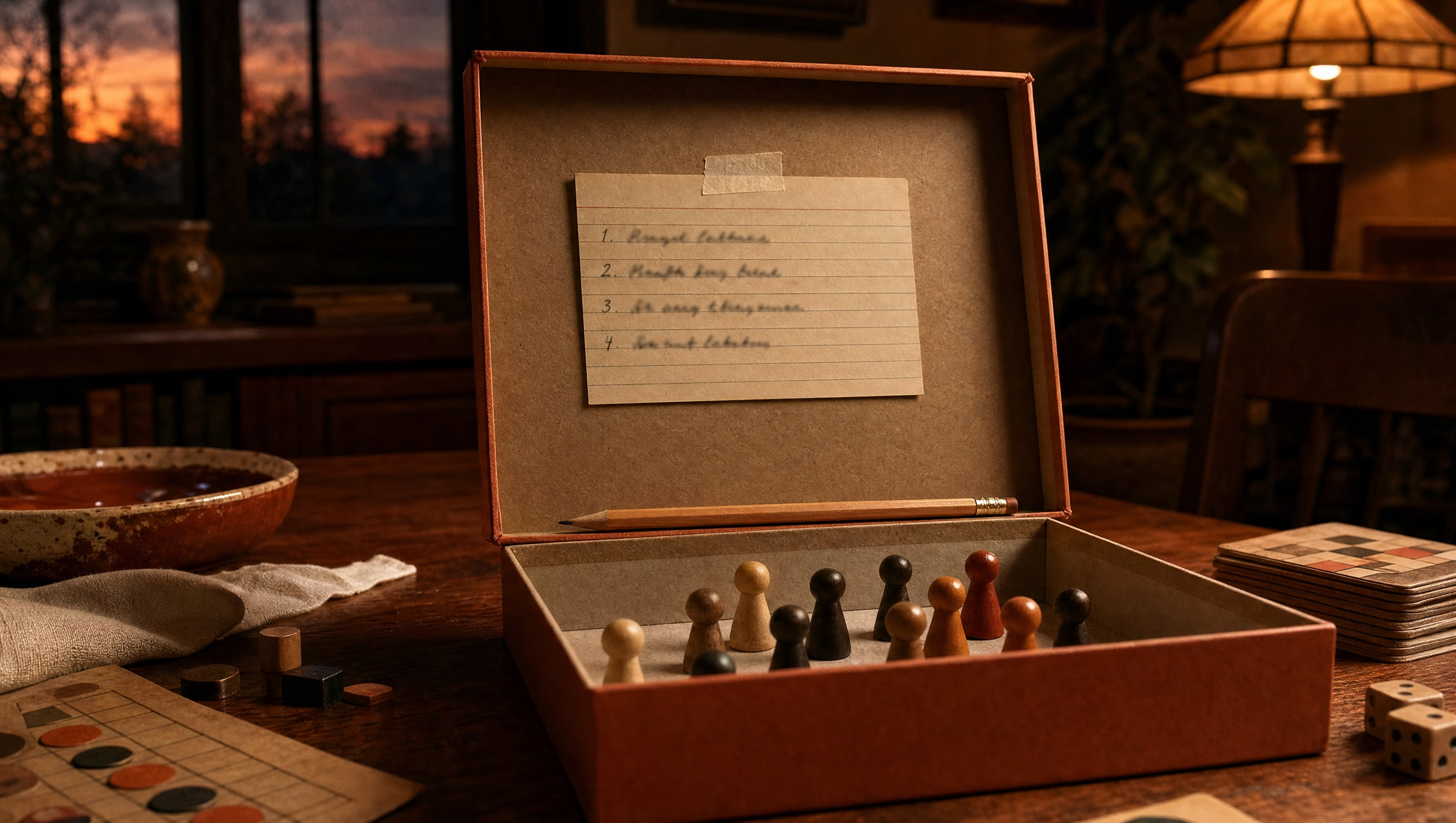
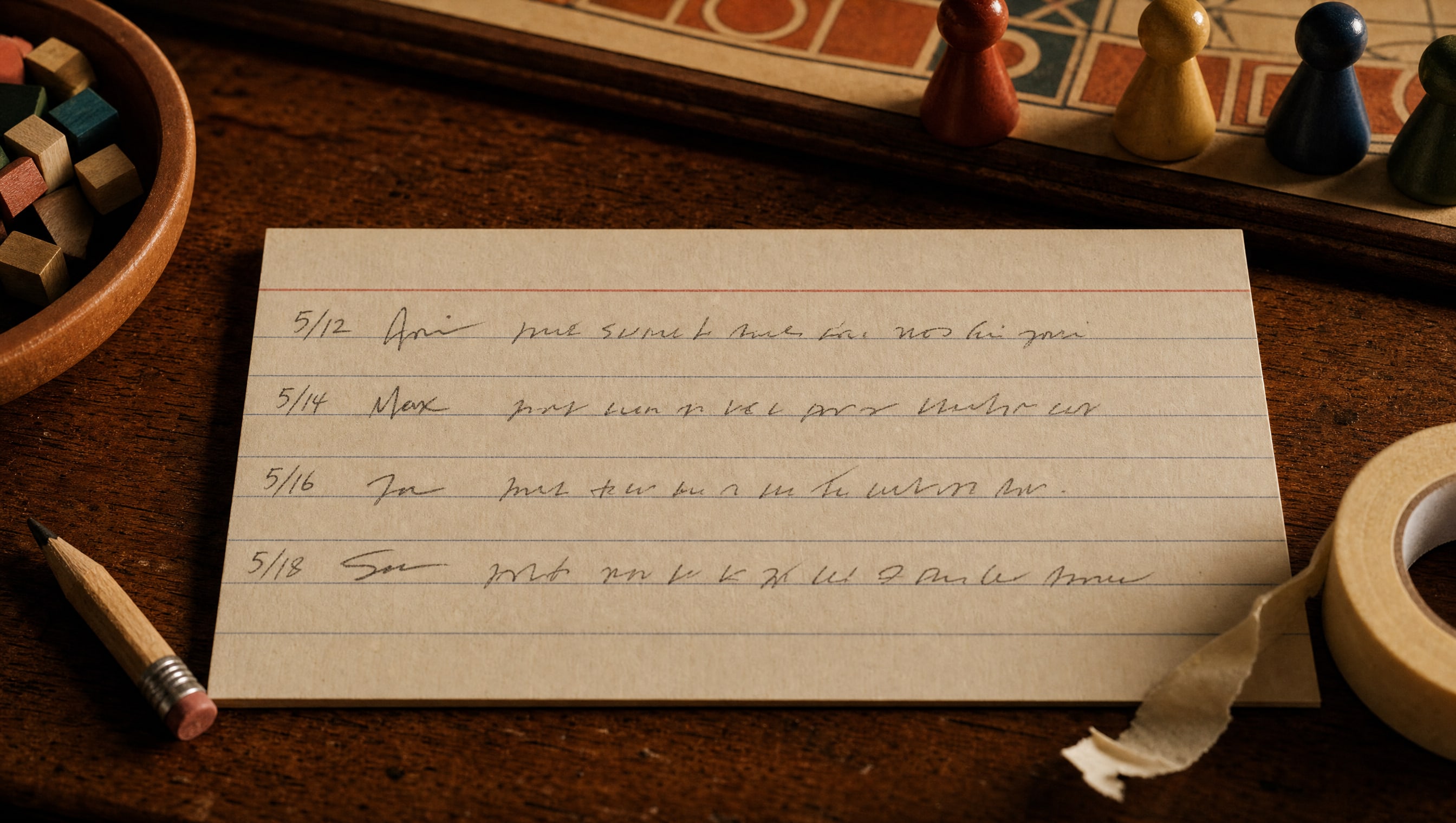
That last part is the bit people skip. A house rule kept in somebody’s head is re-argued every single time it comes up, and the person who remembers it most confidently is usually the person it favours. On a card taped inside the lid — one line per rule, the date, and the name of whoever asked for it — it stops being a claim and becomes furniture. It also becomes repealable, which matters more than it sounds: the rule you wrote for a five-year-old is still on the card when they are nine, and a written rule can be voted out without anybody having to relitigate what was agreed.
THE DETAIL
The face runs from the rule as printed to the rule as your family plays it, and the scale between them is not opinion — it is how far back a change reaches into play that has already happened. Four detents: a change that reaches nothing already played, one that reaches the next move, one that reaches the plan somebody made at setup, one that reaches what winning is. Each detent carries the deadline that falls out of it, which is the whole practical payload of this page. Three ordinary house rules are parked on the face at the deepest detent they reach, and the ledger works the middle one line by line so you can see the reading is a count rather than a verdict.
THE READING, WORKED ON NEEDLE 03
NOBODY GANGS UP REACHES
SO THE NEEDLE PARKS ATDETENT 03
5 PIECES · ON THE TABLE
What this path is holding room for. Nothing here is a link yet — these are the pieces being written for this space.
01
The three sentences that turn a ruling back into a rule, and the one case where you finish as printed and fix it afterwards.
BY POPPY · 5 MIN
02
One line, one date, one name. What a rule card has to say, and the two things it must never say.
BY POPPY · 4 MIN
03
Handicaps that read as rules rather than pity — and why every one of them belongs in setup and never mid-game.
BY IRIS · 6 MIN
04
The rule you wrote for a five-year-old is still on the card at nine. A short repeal that nobody resents.
BY IRIS · 5 MIN
05
Free money, no punishment, no way to lose ground: the kindnesses that stretch an evening into an endurance test.
BY POPPY · 6 MIN
SPACE 09 / 16 · CHAPTER 04 · FAMILY & KIDS
Every chapter in this region is a space on this board. This one is 09. Back to the board to roll for another.