01
How to measure a bay before you buy the shelf
Three numbers on the back of an envelope: clear depth, clear height, clear span. The one people forget is the one that decides.
BY POPPY · 6 MIN
 How To: Gaming
THE HOW TO CO. — EDITION 10
How To: Gaming
THE HOW TO CO. — EDITION 10
A shelf is three numbers — how deep it is, how much the span will carry, and how wet the air is at that height. Get those right once and the boxes outlive the games.
THREE NUMBERS, ONE AXIS
Nothing in a collection is worn out by being played. It is worn out by the shelf it goes back onto.
Boxes do not fail dramatically. A lid stops closing because the insert underneath it has taken a set. A corner goes soft because the box spent two years fourth from the bottom of a flat stack. A board develops a lazy curve along its fold because the air where it was kept sat above sixty per cent for a winter, and nothing you do afterwards takes that curve back out. All three are storage, and all three are decided by measurements taken once, before anything is put away.
There are only three of them, and a shelf either satisfies them or it does not. Depth decides what you are able to keep at all — width only decides how many, and you can always add a bay. Load decides whether the span holds its line or takes a permanent sag, which is what starts crushing the boxes standing on it. And the air — the one nobody measures — decides whether cardboard stays flat, and it changes by a surprising amount between the skirting board and the top shelf of the same unit.
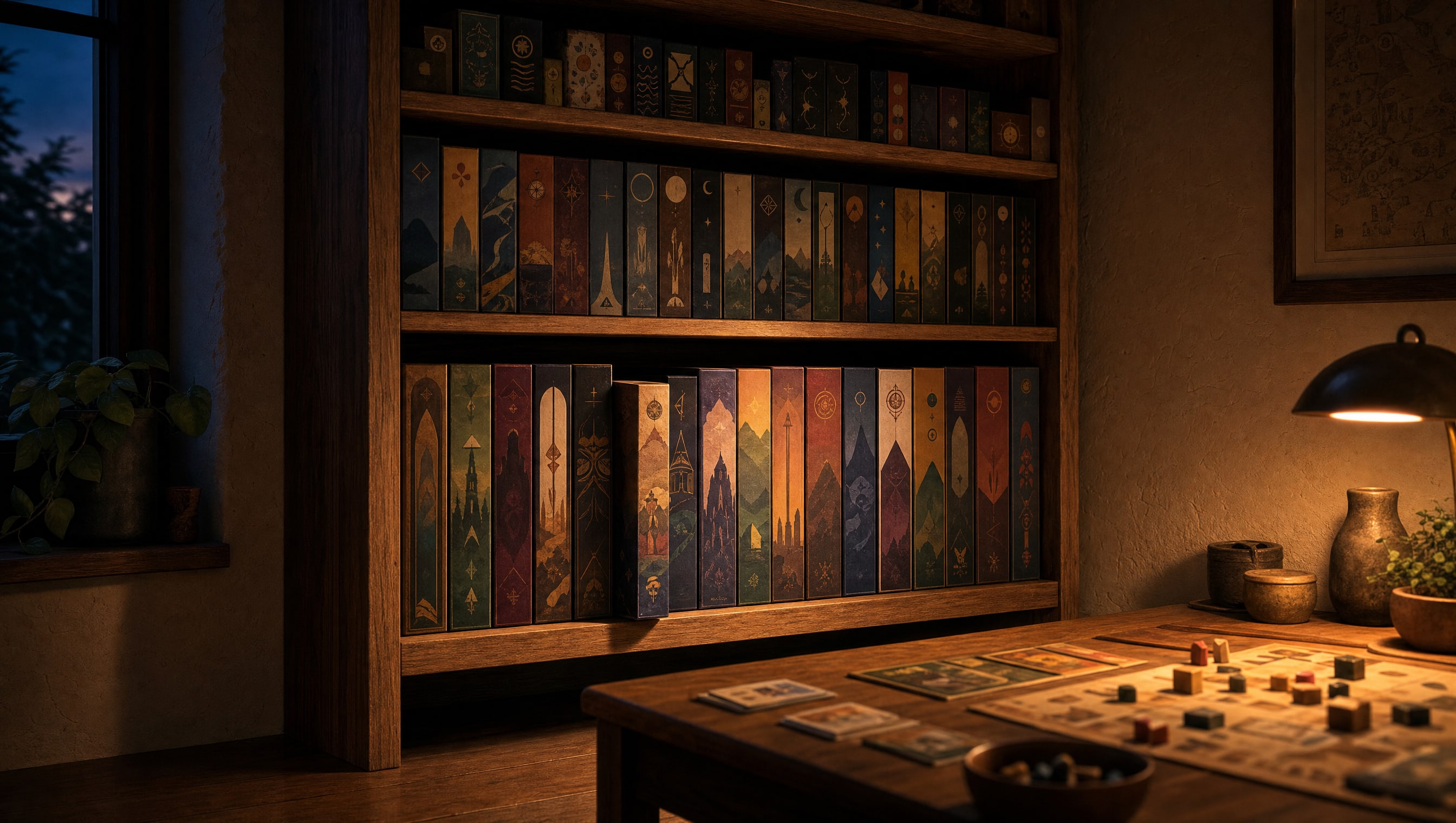
The drawing below is one bay of a standard 2100 mm unit, cut through and set against a true height scale, with all three hung on that single axis. Everything it argues follows from one thing: a board game box is a heavy, hollow, laminated paper object, and the only two forces that ever destroy it are weight from above and moisture from below.

01 · DEPTH
Take the deepest box you own, add ten millimetres, and refuse any shelf shallower than that. A big square box is about 295 mm on its longest side, so 300 mm of clear depth takes essentially everything and 250 mm takes almost nothing — and the two look identical in a shop. A box that hangs proud of the front edge is not stored, it is balanced, and the first thing to go is the corner that carries all of it.
02 · LOAD
A 900 mm span of 18 mm board carries roughly twenty kilograms before it takes a set you can see along its front edge. At around 1.4 kg a box that is a dozen games, and heavy boxes are heavier than that — eleven of the big ones will do it on their own. The fix is not a stronger shelf. It is a shorter span: a centre upright, or a batten screwed to the wall behind, and the arithmetic stops mattering.
03 · THE AIR
Paper and board keep best between forty and fifty-five per cent relative humidity. In a heated room in winter the air at the skirting is the same air a few degrees colder, which reads several points wetter — often above fifty-five in the bottom half metre, and higher again against an outside wall. Keep the bottom shelf off the floor, put nothing irreplaceable in that band, and buy the eight-pound hygrometer rather than guessing.
04 · ORDER
Heavy low, light high, and the twelve you actually play between waist and eye. Low is right for weight and wrong for damp, which is why the bottom shelf wants a plinth under it rather than the floor. Above about 1700 mm you are lifting a two-kilogram box down over your own head, so that shelf gets the small boxes and the expansions. A collection you cannot reach is not a collection, it is storage.
THE DETAIL
A section through one bay of an ordinary 2100 mm unit, drawn to a true vertical scale in millimetres above the floor. Everything that decides whether these boxes survive is hung on that one axis. Down the middle, 66 boxes standing on their spines at their real thicknesses. To the right of them, what each 900 mm span is actually carrying, against the twenty kilograms an 18 mm board takes before it sags. Behind both, the humidity of the air at that height — which is not one number for the room, and is worst exactly where people put their heaviest games.
5 PIECES · ON THE TABLE
What this path is holding room for. Nothing here is a link yet — these are the pieces being written for this space, and a door that opens onto nothing costs you a click to find out.
01
Three numbers on the back of an envelope: clear depth, clear height, clear span. The one people forget is the one that decides.
BY POPPY · 6 MIN
02
Where the weight goes, when a 900 mm span needs a centre upright, and what a bowed board quietly does to the boxes standing on it.
BY IRIS · 7 MIN
03
The bottom half metre, the outside wall, and the cheap hygrometer that ends the argument about whether it is fine.
BY IRIS · 6 MIN
04
Inserts, shrink wrap and the lid that no longer sits down: why a box usually fails long before the shelf holding it does.
BY POPPY · 5 MIN
05
Oversized boxes, campaign boxes and long expansions — the four that break every bay, and the two places they are safe to live.
BY POPPY · 6 MIN
FROM THE CURATOR
The unit fitted the alcove to the millimetre and I was extremely pleased with myself for about fourteen months. Then I pulled out a box that had lived on the bottom shelf against an outside wall and the lid had gone soft at one corner, and the board inside had a slow curve in it that no amount of weight would flatten. A hygrometer cost me less than a small expansion and told me the bottom of that alcove sat over sixty per cent all winter. Nothing on that shelf was wet. It was just never quite dry, which turns out to be the same thing given long enough. The unit is still there. The bottom shelf now holds the games I would replace without minding.
BY POPPY — CLASS: CURATOR · THEPINKPIPER.GG
SPACE 13 / 16 · CHAPTER 05 · COLLECTING & CARE
CHAPTERS ON THIS BOARD
You are standing on space 13 — Collecting & Care — on the first of its three paths, the shelf. Back to the board to roll for another.