 HOWTO: GAMING

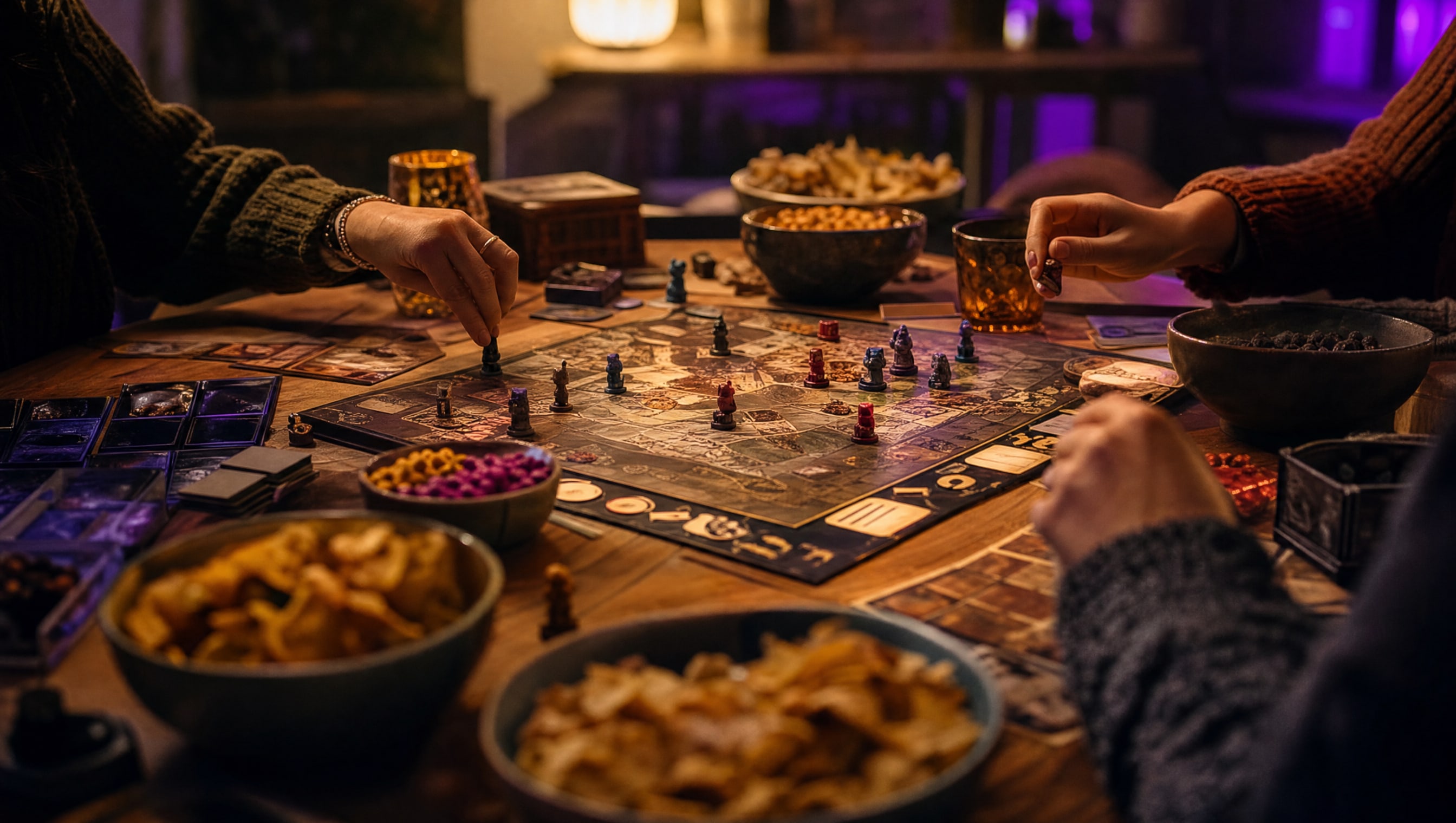
I will be honest with you: I play to win, every time, at everything, and my friends still come back every other Friday. Those two facts can coexist! The secret is that game night has two games running at once — the one in the box, and the one where everyone at the table has a good enough time to return. You're allowed to win the first one as hard as you want, as long as you never lose the second.
THE PLAN, IN ONE BREATH
- 01Read the room first
- 02Pick the game for the group
- 03Teach fast, lose the manual
- 04Win the right way
- 05Defuse the table bombs
- 06Host the body, not just the brain
- 07End on a high note, on purpose
Read the room before you read the rules
Before you even pick a game, figure out what table you're at tonight. Is this a "we're here to hang out and cards are the excuse" night, or a "we came to compete" night? Same friends can be different tables on different Fridays — someone's exhausted from work, someone brought a new partner who's never gamed, someone is in a Mood.
Match your intensity to the room, not the other way around. Full tryhard mode at a hangout table is how you win a game and lose an evening. Save the sweat for the nights the table wants it — those nights are glorious.
Pick the game for the group, not for you
The host's classic mistake is picking their favorite heavy game for a table that wanted snacks and chaos. My shelf sorts by weight: party tier for big mixed groups — Codenames handles up to eight-plus and teaches in two minutes; gateway tier for four-ish people with mixed experience — Ticket to Ride or Cascadia, 45 minutes, easy teach, real decisions; and the heavy stuff only when everyone at the table opted in knowing what they signed up for.
New person present? Drop a full weight class. Nobody's first game night should involve a 20-page rulebook, and the fastest way to make an enemy is to make someone feel stupid at your table.
Teach fast and lose the manual
Reading rules aloud is where game nights go to die. Learn the game yourself beforehand — actually set it up solo and play a few dummy turns, it takes twenty minutes — and then teach it in this order: what winning looks like, what a turn looks like, go. Details come up when they come up. First game is a practice round and everyone knows it.
And when a rules argument starts, the host's ruling ends it in ten seconds: make a call, say "we'll look it up after," move on. No game night has ever been improved by three people reading the same paragraph on their phones with increasing volume.
☆ THE TEACH ORDER
what winning looks like,
what a turn looks like,
go.
☆ RULES ARGUMENT, ENDED
make a call,
say "we'll look it up after,"
move on.
THE TITLE QUESTION, ANSWERED
Winning doesn't make enemies — how you win does.
Win the right amount, the right way
Now the actual title question. Winning doesn't make enemies — how you win does. The rules I play by: never narrate your own brilliance ("and THAT'S why you don't leave the six open" is a sentence that has ended friendships), never pick apart the loser's mistakes afterward unless they ask, and compliment one real thing someone else did the moment the game ends. Not fake — find something true. There's always something true.
And if you're winning every single game by miles, the fun move is handicapping yourself quietly: try a weird strategy, play the faction nobody picks. You still get your challenge; the table gets a race. Dominance is only fun for one person, and long-term, it isn't even fun for them.
Defuse the two classic table bombs
Two situations create most game night grudges. The pile-on: when everyone attacks the leader (fine, that's the game) versus when everyone attacks the same player all night regardless of position (not fine, that's a bad memory forming). If you see it, redirect it — "she's not even winning, hit the actual leader" costs you nothing and someone's whole evening gets rescued.
The kingmaker: a player who can't win deciding who does, usually out of spite. Best defused before it happens by picking games with hidden scoring or fast endings for grudge-prone groups. If it happens anyway, let it go with grace — the person who shrugs off a kingmaking is remembered as fun; the person who litigates it for twenty minutes is not.
☆ THE REDIRECT
"she's not even winning,
hit the actual leader"
Host the body, not just the brain
Comfort does more for game night harmony than any rule I know. Real chairs. Table space where every player can reach their stuff — a 36x36 inch playmat defines the arena and keeps drinks off it, because coasters at the perimeter mean the one spilled soda of the year lands on wood, not on someone's card fan. Snacks in bowls people can reach one-handed, nothing greasy — dorito dust on sleeved cards is a war crime in at least eleven jurisdictions.
Warm light, drinks refilled between rounds, music low enough to talk over. A comfortable loser had a better night than an uncomfortable winner. That's just physics.
End on a high note, on purpose
Don't let game night die of exhaustion at 1 a.m. with a half-finished heavy game and four zombie friends. Plan the arc: big game in the middle when energy peaks, then a short loud closer — a fifteen-minute party game or a few hands of something silly — so the last memory of the night is everyone laughing.
Then, and this is the sneaky one: whoever won the big game does NOT get to pick the closer. Little ritual, costs nothing, and it tells the table that winning here buys glory but not power. That's the whole culture in one rule.
✿ WHAT I USED
The game-night shelf
Comfort does more for game night harmony than any rule I know.
SOME LINKS EARN POPPY A LITTLE COMMISSION. THE SNACK BOWL FUND THANKS YOU.
Quick answers
Should I let people win sometimes?
Throwing games is usually more insulting than losing, and people can tell. Instead, level the field honestly — handicap yourself, play experimental strategies, or pick games with more luck in them so everyone genuinely can win.
How do I handle a sore loser in the group?
Shorter games, more of them — losses sting less when the next game starts in ten minutes. Pick titles with hidden scores or co-op games for a while, and never join a pile-on against them; sore losers often soften once losing stops being a public event.
What's the ideal group size?
Four or five for real board games, six to ten for party games. Above that, split into two tables rather than forcing one giant game — two happy tables beat one slow one every single time.
Play like you mean it, cheer like you mean it, and be the table everyone wants back — that's the real win condition.
— POPPY ✿ QUEST 05 COMPLETE