 HOWTO: GAMING
Roughly one in every forty "deals" I see at card shows is a fake, and the ratio gets worse the hotter the card. Here's the ten-second routine, in the order I actually run it. The moment one check fails, you're done.
THE ROUTINE, IN ORDER
- {{ t.num }} {{ t.label }}
The ten seconds
0.0 – 10.0sTilt it under light first
Real holofoil is printed in layers, and the shine lives under the ink. Tilt the card 45 degrees under any decent light source. On a genuine holo, the art stays crisp while the foil pattern moves beneath it. On most fakes, the whole surface glitters at once — including areas that should be flat, like the text box and borders.
This one check kills the majority of counterfeits. Fakers buy holographic sheet stock and print on top of it, so the entire card sparkles. Charizard's flame should shine. The attack text should not.
Check the print pattern with a loupe
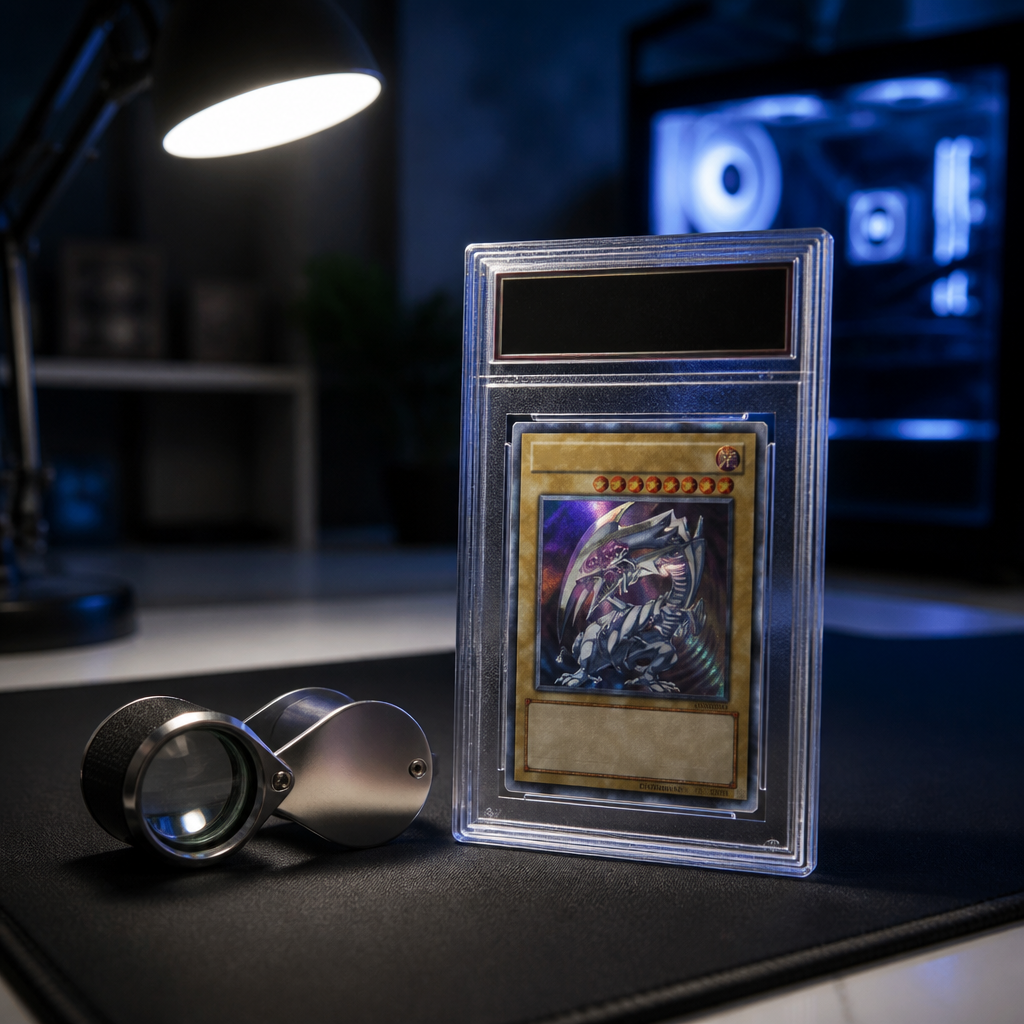
Get a 10x jeweler's loupe on the artwork. Genuine cards are printed with offset printing, which leaves a tight, regular rosette pattern of dots. Fakes are usually inkjet or cheap digital prints — under magnification the dots look smeared, oversized, or laid in straight lines instead of rosettes.
This takes three seconds once you've done it twenty times. Practice on cards you know are real. Bulk commons from a booster pack you opened yourself are a free training set.
Read the font and the details
Counterfeiters get the big art right and the small stuff wrong. On Pokémon cards, check the energy symbols — fakes routinely print them slightly oversized or off-center. On One Piece cards, the DON!! symbols and the copyright line are the common failure points. On sports cards, cheap fakes fall apart at the foil stamping: real stamps are crisp at the edges, fake ones bleed.
Spelling errors still happen more than you'd believe. "Trainer" with a lowercase t has saved buyers real money.
Still not sure
WHEN 10s ISN'T CLEANFeel the card stock
A real trading card is a sandwich: two paper layers around an opaque core. Pokémon and Magic use a colored core layer — hold the card edge-on and look for it. Fakes printed on single-layer stock feel slick, flimsy, or oddly stiff, and they bend wrong.
Run the light test on the back
Hold the card up against a bright light, back facing you. A genuine card with an opaque core blocks most light evenly. Many fakes glow like a lampshade, or show the front image bleeding through. On Magic cards, the blue core layer shows as a clean line on a real card's edge; a fake edge looks like plain white paper.
Weigh it if you're still not sure
A standard modern TCG card runs about 1.7 to 1.9 grams. A pocket gram scale that reads to 0.01 grams settles arguments fast. Fakes on cheap stock often come in under 1.6 grams or over 2 grams. Weight alone isn't proof, because humidity moves the number a little, but combined with a failed tilt test it's a conviction.
CASE FILE · THE RIP TEST
Do not do the rip test on a card you don't own. I've watched a guy tear a real Base Set holo in half at a show to "prove" it was fake. It wasn't. Respect the hobby.
SPEC · WHAT A REAL CARD WEIGHS
genuine: 1.70 – 1.90 g
suspect: < 1.60 g or > 2.00 g
humidity drift: ± a little
The big money
FOUR FIGURES = SLOW DOWNCompare against a known-real copy
For expensive purchases, nothing beats a reference card. Same set, same era, ideally the same card in a cheaper condition. Print quality, color saturation, corner cut, foil behavior — line them up and differences jump out.
When I evaluate a vintage holo, I bring a beat-up played copy of a common from the same set. The printer didn't change between the common and the chase card. The counterfeiter never gets both right.
Know when ten seconds isn't enough
The routine above catches the 95% of fakes that are cheap. The dangerous 5% are rebacked cards, trimmed cards, and high-end counterfeits of vintage grails. If someone offers you a raw Base Set Charizard, an Alpha dual land, or a 1st edition anything at a price that makes your heart rate jump, slow down.
For four-figure cards, buy graded from reputable sources or pay a grader to authenticate. The $19 to $25 economy grading fee is the cheapest insurance in the hobby.
+ THE KIT
The authentication bench
Under $60 for the whole bench. Cheaper than one bad deal.
SOME LINKS EARN IAN A COMMISSION. IT FUNDS THE REFERENCE BINDER.
Quick answers
{{ f.q }}
{{ f.a }}
Ten seconds of checking beats ten weeks of regret — protect the cardboard, and it protects you back.
— IAN + CASE 01 CLOSED