01
How to read a blind-box leaflet before you buy the series
The roster, the printed rate and the one line that tells you what a sealed case is supposed to contain.
BY POPPY · 5 MIN
 How To: Gaming
THE HOW TO CO. — EDITION 10
How To: Gaming
THE HOW TO CO. — EDITION 10
A blind box is not a lottery ticket. It is a published roster sold one sealed cube at a time, and almost everything the market does to it follows from that single decision.
THE FORMAT
Pop Mart did not invent the blind box. What it did was standardise one, at a scale nobody had tried before — and once you can read the standard, most of what looks like luck on this shelf turns out to be printed on the packaging.
The object is a designer toy: a small vinyl figure, most of them somewhere between six and ten centimetres, sculpted by a named artist rather than lifted from a film. The line runs back to Hong Kong in the late nineteen-nineties, and it was Medicom in Japan and Kidrobot in New York that first sold work of that kind sealed in identical boxes with the rarity of each design printed on the insert. Pop Mart — founded in Beijing in 2010, listed in Hong Kong ten years later — took that arrangement and built a retail chain on top of it: shops, the vending machines it calls roboshops, an app. What it did not change is the arrangement itself. The artist owns the character; the company owns the distribution; and the series is the unit both of them work in.
A series is a fixed roster. Twelve regular designs as a rule, announced together, sculpted together, and sold at one price in boxes so identical that no box on the shelf tells you anything whatsoever about itself. That is the entire trick and it is a very old one. The sealed unit is what turns twelve objects into one habit: a collector standing at the display is not buying a figure, they are buying an attempt at a figure, and the price of an attempt is small enough that the decision barely registers as a decision.
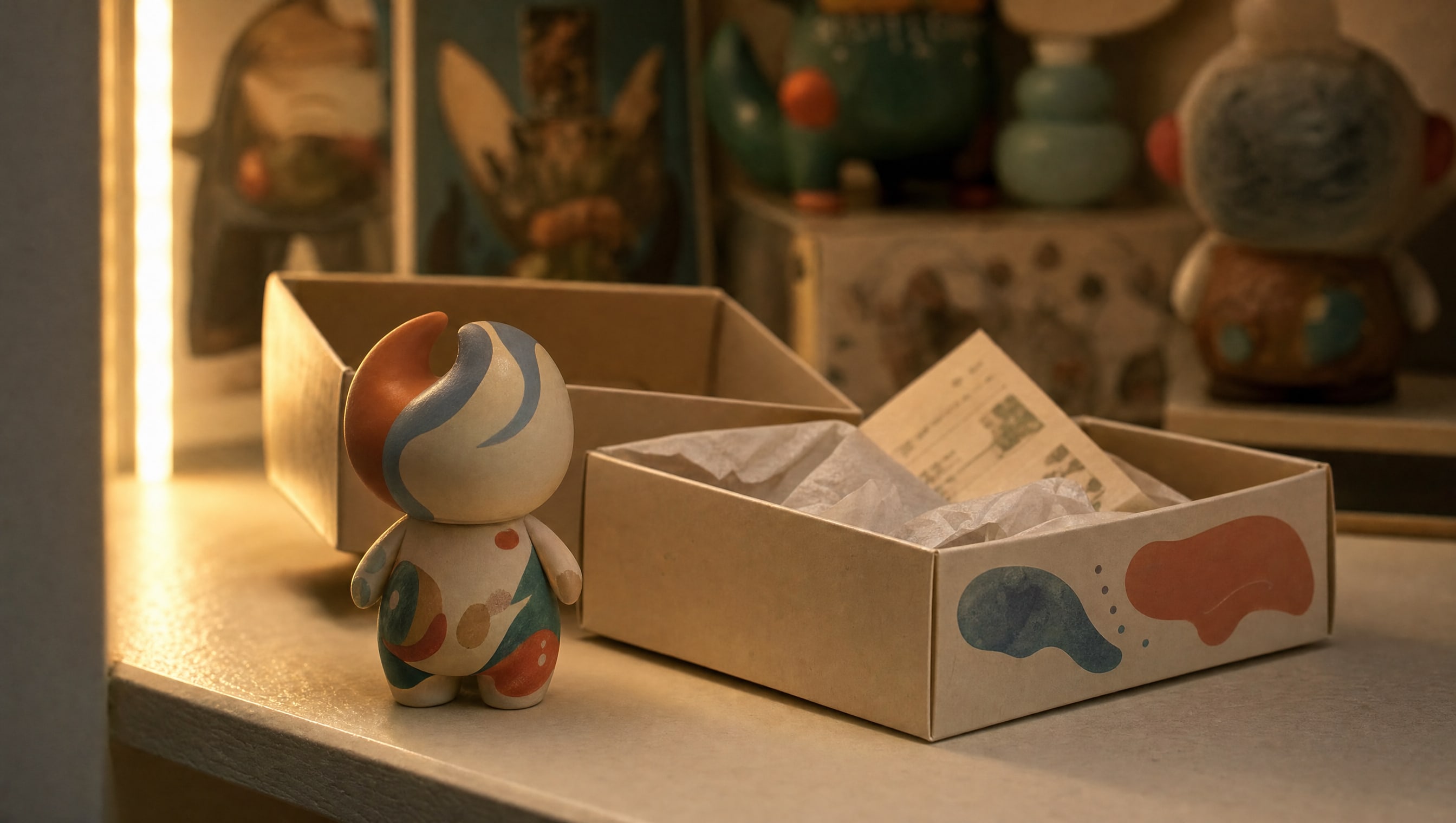
Above the roster sits the secret, sometimes called the hidden edition. It is a thirteenth sculpt, usually a variant of one of the twelve — a colourway, a pose, a finish — and it is not sold. It is seeded. Most series print the rate on the leaflet folded inside the box, and the figure most often printed is one in a hundred and forty-four. That number is not decoration. A hundred and forty-four boxes is exactly twelve sealed cases, which is where this stops being a story about luck and becomes arithmetic — the subject of the next case along this shelf.
The case is the third term, and it is the one most new collectors never hear said out loud. Boxes do not reach a shop loose; they arrive inside a sealed display case of twelve, and in a twelve-design series that case holds one of each. Buy the sealed case and you own the roster. Buy twelve loose boxes off a shelf and you own an argument. Collectors in mainland China have a verb for taking the whole tray, and the price of doing it is simply twelve times the price of one — no premium, no discount. What you give up is the opening, which for a good many people was the thing they were buying.
And the secret does not sit outside that arithmetic politely. It takes a regular design's place in the case it lands in, which means the one case in twelve that carries a secret is also the one case that comes up a design short of the set. There is no purchase, at any price, that promises you the thirteenth sculpt. That is the format working exactly as designed, and it is worth understanding before rather than after.
THE DETAIL
Two registers of the same series. Above, the published roster: twelve regular designs and the secret that hangs off them, drawn as a thirteenth plate because that is what it is — a sculpt, not a slot. Below, a hundred and forty-four boxes grouped into the twelve sealed cases they actually ship in, at the rate most series print. Every case is twelve boxes, the eighth one included: its last box is the secret, and the dashed plate hanging outside it is the regular design that secret displaced. The case is short of a design, never of a box.
FOUR THINGS · IN ORDER
The primary price is fixed and public and the same for every box in the series. Everything interesting happens after it — and almost none of it happens to the roster as a whole.
5 PIECES · IN THE ARCHIVE
The archive behind this label, written in the order the format teaches itself. Titles are set and the pieces are being drafted — nothing here links yet, because a label pointing at an empty case is worse than a label that says wait.
01
The roster, the printed rate and the one line that tells you what a sealed case is supposed to contain.
BY POPPY · 5 MIN
02
What a case costs, what it guarantees, and the two reseller habits that quietly break the guarantee.
BY POPPY · 6 MIN
03
Queues, app releases and the five minutes in which most of this hobby’s regret is generated.
BY IRIS · 4 MIN
04
Why an average across twelve designs describes nothing, and the three listings to read instead.
BY IRIS · 6 MIN
05
Leaflets, seals, sunlight and the tidy shelf that quietly halves what a complete set is worth.
BY POPPY · 5 MIN
SHELF 02 / 07 · BLIND BOXES · CASE 01 / 03
Every chapter in this region is a bay on this wall. This one is 02, and you are at case 01 of 03 on it — Pop Mart. Back to the wall to walk the rest.