01
How to read a rulebook back to front
End condition, then the turn, then the components. The order that turns forty pages into a page and a half of reference.
BY POPPY · 6 MIN
 How To: Gaming
THE HOW TO CO. — EDITION 10
How To: Gaming
THE HOW TO CO. — EDITION 10
Turn order, actions, an engine, an ending. Every modern box is those four systems wearing a costume — and the costume is the only part that ever changes.
THE PART THAT NEVER CHANGES
You will be taught forty games in your life. There are four things any of them can do to you.
A rulebook is written for somebody who already owns the game. It opens with an inventory of the box, closes with an appendix of edge cases, and mentions exactly once — usually on page nine, in a paragraph nobody reads aloud — the only sentence that decides how you should play: what makes the game stop. Underneath that ordering, every modern box runs the same four systems, in the same order, on every single turn.
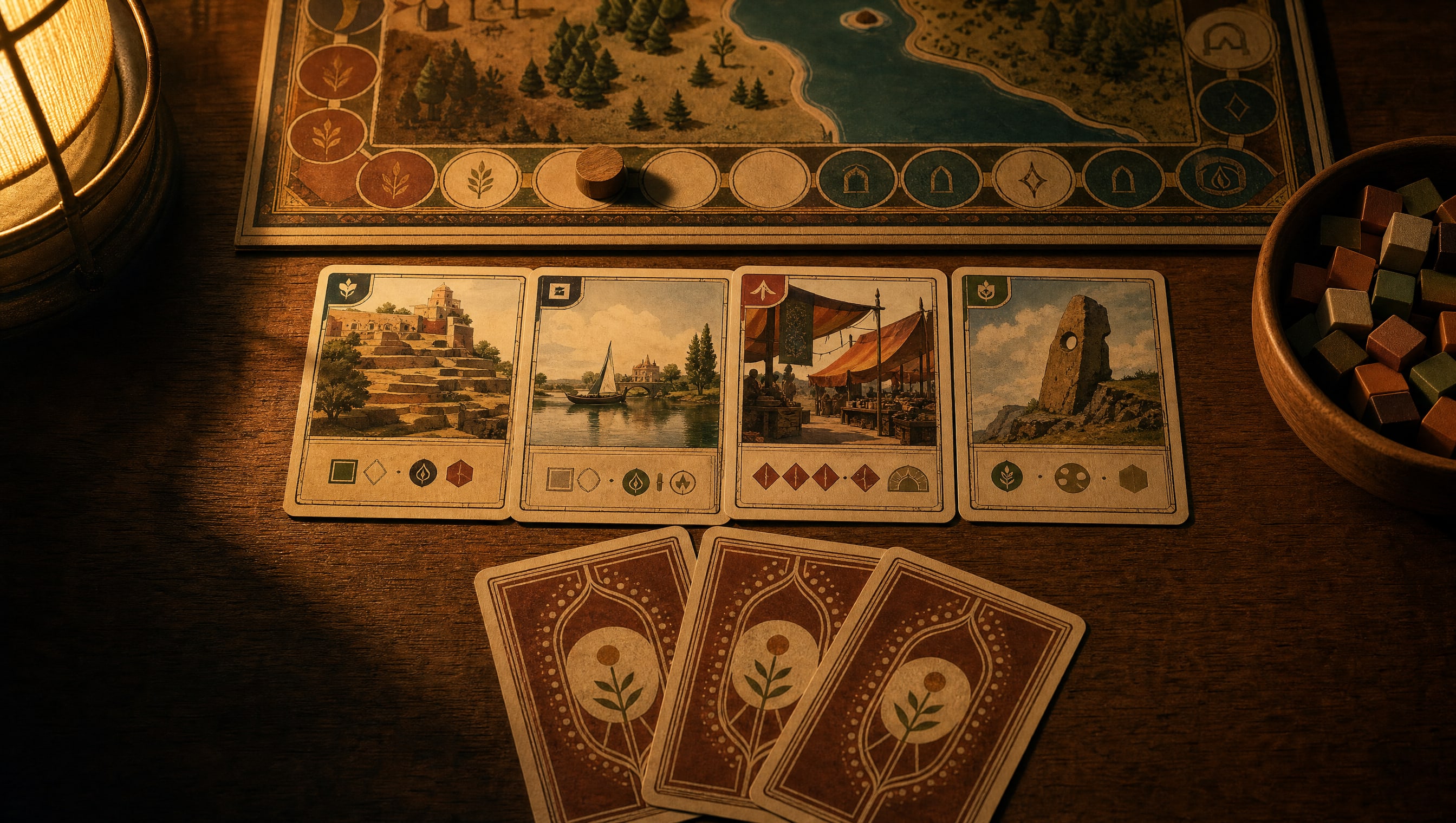
01 · TURNS
Who acts, and when the right to act moves on. Most games pass it clockwise and never mention it again. Some sell it: you bid for it, you inherit it from what you did last round, or everybody acts at once and the whole tension is in the reveal. When turn order costs something, that is almost always where the real game is being played.
02 · ACTIONS
The menu — what you may do with a turn once you have one. This is the layer the theme is painted on, and the layer that eats most of the rulebook, which is why teaching straight from the book feels like reading a menu to somebody who has not decided whether they are hungry. Placing a worker, playing a card and spending a die are one verb in three coats: take an option, and take it away from everyone else.
03 · ENGINES
Memory. Whatever makes this turn better than your last one — a deck you have been quietly editing, a row of cards that unlock other cards, a network on the board that pays you for being large. Engines are why the middle of a good game accelerates and why the first two turns feel thin. If nothing you do now changes what you can do in three turns, there is no engine, and you are solving a puzzle rather than building a thing.
04 · ENDINGS
The instruction the whole game is written in. A fixed count of rounds means spend everything, because there is no later. A trigger any player can pull means watch whoever is closest to pulling it. A race to a number means the number is the map. Read the ending first and the rest of the rulebook stops being a list and starts being an argument about how to get there.
THE DETAIL
Position on the ring is position in the turn: the turn arrives, you spend it on an action, the action feeds whatever you are building, and what you are building eventually trips the ending — which hands the turn on again. Twelve mechanic families sit on the side they belong to. A line across the middle means both families run together in one real game, and that game is named on the line. None of these are genres. A game is a route around this ring.
5 PIECES · ON THE TABLE
Five pieces queued for this space. Titles are set and the drafts are moving; nothing is linked here until the page exists, because a door that opens onto nothing costs you a click to find out.
01
End condition, then the turn, then the components. The order that turns forty pages into a page and a half of reference.
BY POPPY · 6 MIN
02
Look for the thing that gets cheaper. If nothing does, the game is a puzzle, and it wants a different kind of attention.
BY IRIS · 5 MIN
03
Upkeep, refills and the phase that quietly resets everything you were counting on lasting.
BY IRIS · 4 MIN
04
Strip the artwork off in your head. If the decisions survive unchanged, you are playing a maths problem about wheat.
BY POPPY · 5 MIN
05
Scoring is a set of instructions written in points. Read where the numbers are largest and play toward that first.
BY POPPY · 7 MIN
FROM THE CURATOR
The night I stopped dreading new boxes was the night I stopped trying to hold a rulebook in my head. Now I ask four things before anybody reads me anything: how does the turn move, what may I do with mine, what gets better if I keep doing it, and what stops the game. Four answers, about ninety seconds, and then I can play badly with confidence — which is the only useful way to play anything for the first time. Everything else in the book is reference, and reference can wait until somebody actually needs it.
BY POPPY — CLASS: CURATOR · THEPINKPIPER.GG
SPACE 01 / 16 · CHAPTER 01 · LEARNING & TEACHING
CHAPTERS ON THIS BOARD
Every chapter in this region is a space on this board. This one is 01. Back to the board to roll for another.